
SpeciesBoa constrictor
Boa constrictor
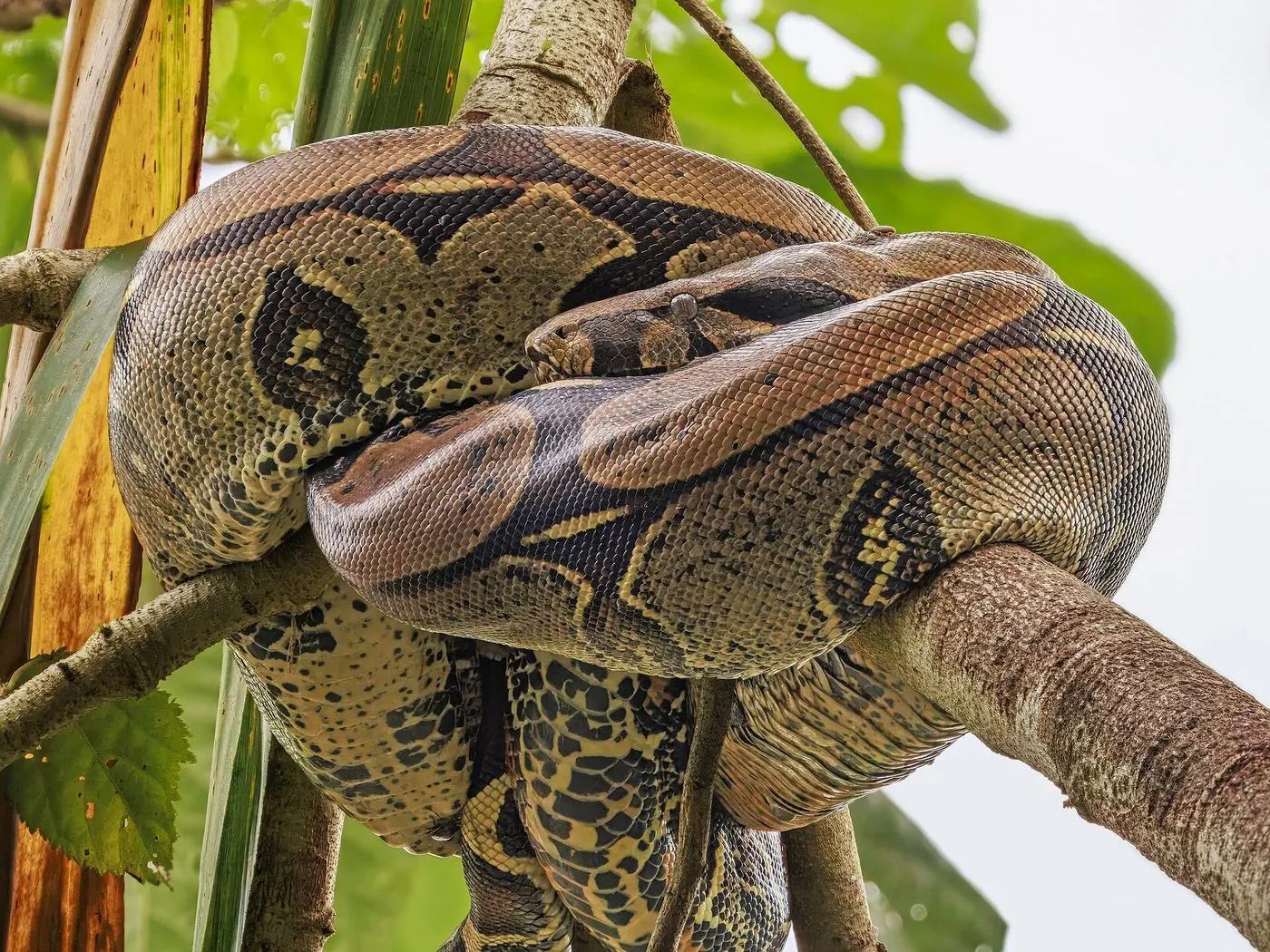
A powerful constrictor that grows considerably larger than most people expect. Anyone keeping one plans the enclosure for the adult animal, not the juvenile.
- Group
- Snake
- Level
- Intermediate
- Origin
- Central and South America
Where the species comes from
- World region
- Central and South America
- Countries
- Mexico, Central America, large parts of South America and individual Caribbean islands
- Habitat
- Tropical forest, dry forest, savannah and scrubland
The natural habitat is the yardstick for how you furnish an enclosure. Knowing where an animal comes from is knowing why it needs heat zones, hides and a particular humidity.
Husbandry at a glance
The same details appear in the animal’s profile inside the app.
- Enclosure
- A very solid, lockable enclosure. The Animal Welfare Ordinance requires at least 1 × 0.5 body lengths of floor area and 0.75 body lengths of height: for a total length of 2 m that is 200 × 100 × 150 cm, for 2.5 m 250 × 125 × 188 cm, more for larger animals. Depending on the locality, adults often reach 180–250 cm or more; what counts is your own animal.
- Temperature
- Basking spot around 31–33 °C, warm zone 27–30 °C, cool zone roughly 24–26 °C; a slight drop at night.
- Humidity
- Usually around 60–75 %, with good ventilation and dry resting areas.
- Lighting
- A clear day–night cycle, bright full-spectrum light and low to moderate UVB are advisable.
- Substrate
- A moisture-buffering soil and bark mix that can be kept hygienic, deep enough to work.
- Furnishings
- Very sturdy branches and platforms, large suitable hides, visual barriers and a robust water bowl.
- Water
- A large, heavy water bowl; clean it frequently.
- Feeding
- Appropriately sized thawed mammals or other suitable prey. Feed adults at long intervals; excess weight is common.
- Behaviour
- Crepuscular and nocturnal, powerful and, depending on the individual, manageable, but very strong.
- Handling
- Handle larger animals only with a second experienced person. Support the body fully.
- Cohabitation
- Keep singly.
- Health
- Monitor weight and body shape closely; watch the airways, mouth, skin and spine.
- Seasonal cycle
- No winter rest: The range extends from Mexico to Argentina and is mostly tropical. For breeding, a cooler phase of eight to ten weeks with a night-time drop to 22–24 °C is simulated. For animals from the south of the range it may be somewhat cooler — clarify the origin.
- Safety
- Large specimens are subject to heightened safety requirements. Locks, an emergency plan and a second person all matter.
Legal position in Switzerland
No permit foreseen
No permit. Art. 89 let. f of the Ordinance expressly exempts the boa constrictor from the permit requirement for giant snakes. It is the only exception named
No certificate of competence foreseen
No proof of competence required. It is only demanded for the animals named in Art. 89 of the Ordinance
Species protection applies
CITES Appendix II, the Argentine subspecies Boa constrictor occidentalis in Appendix I. Import and transfer only with papers. When buying, ask for proof of origin and captive breeding
Minimum enclosure dimensions
Annex 2, table 5 of the Animal Welfare Ordinance does not prescribe centimetres but multiples of body length. For this species, item 43a (Small and medium pythons and boas): floor area 1 × 0.5 body lengths, height 0.75 body lengths. The floor area applies to at most two animals; each further animal requires an additional 0.5 × 0.2 body lengths.
For this group, body length means the total length, from snout to tail tip. The largest animal in the enclosure is what counts. The enclosure may not be smaller even if fewer animals live in it than the table names.
| Total length | At least |
|---|---|
| 150 cm | 150 × 75 × 113 cm |
| 200 cm | 200 × 100 × 150 cm |
| 250 cm | 250 × 125 × 188 cm |
| 300 cm | 304 × 152 × 220 cm |
| 350 cm | 383 × 192 × 220 cm |
For the larger animals the calculation would give a height above 2.2 m. The ordinance allows stopping at 2.2 m but requires a proportionally larger floor area in return, so that the volume is met. The table above already accounts for this.
Animals may temporarily be kept in smaller enclosures: for quarantine, for the treatment of illness and injury, for acclimatisation, for breeding and rearing, and for winter or cold dormancy or aestivation (preliminary remark D on reptiles).
This is the legal lower limit, not a recommendation. An enclosure that meets exactly these dimensions is permitted, but not good for that reason. The details under “Husbandry at a glance” work out this minimum for adult animals; they give the minimum, not the ideal.
What the enclosure must provide
The enclosure must be escape-proof and provide species-appropriate temperature zones, humidity, hides, water and, where applicable, raised resting areas. Unusually large, dangerous or commercial set-ups may be subject to further rules.
Paperwork
Keep an unbroken proof of origin and the purchase contract. Clarify CITES permits and species protection checks in advance of any border crossing.
These details are a guide, not legal advice. Binding information comes from the cantonal veterinary office; the text of the ordinance is what counts. More on the legal position

_Rio_Napo.jpg)