
For keepers in Switzerland
Keeping reptiles: What the law requires
In law, reptiles count as wild animals. Their keeping is therefore subject to rules of its own: minimum enclosure dimensions, a cantonal permit for some species, plus proof of origin and expertise. This page explains the essentials and what ReptiCare takes on from them.
Up front, so there is no misunderstanding
This page is general orientation, not legal advice. Binding information for your case comes solely from the cantonal veterinary office. The current text of the ordinance always prevails, not this summary.
The legal basis
The basis is the Animal Welfare Act, implemented by the Animal Welfare Ordinance (TSchV, SR 455.1). For reptiles, two passages matter above all:
- Annex 2 with the preliminary notes on reptiles, and Table 5 (reptiles) and Table 6 (amphibians): These set out the minimum requirements for enclosures and their furnishing.
- Article 89 with the list of wild animals whose private keeping requires a permit.
The revised Animal Welfare Ordinance came into force on 1 February 2025; individual provisions have transitional periods or come into force later. Because this can change, it is always worth checking the current version on Fedlex before any major decision.
Do I need a permit?
For most commonly kept species (corn snake, ball python, leopard gecko, bearded dragon, crested gecko) private keeping normally requires no keeping permit. Subject to a permit are, among others:
Chameleons
Every chameleon requires a permit: From the veiled chameleon to the leaf chameleon.
Giant snakes over 3 m
Reticulated, Burmese and African rock pythons, anacondas and others. The boa constrictor is expressly exempt from this permit requirement.
Venomous snakes
Snakes with a functioning venom apparatus able to use it. Only species expressly designated harmless by the FSVO are exempt.
Large lizards
Iguanas, tegus and monitors that exceed 1 m when fully grown, plus beaded lizards, sailfin lizards, marine iguanas and other expressly named species.
Crocodilians and tuatara
Crocodiles, alligators, caimans, gharials and tuatara (Sphenodon).
Certain turtles
The African spurred tortoise (Centrochelys sulcata), snapping and alligator turtles, snake-necked turtles, pelomedusa turtles, large softshell, South American river and Asian river turtles, and giant and sea turtles.
Certain amphibians
Goliath frog and giant salamander. A certificate of competence is not enough here: a qualified animal keeper is required or, with only one group of animals, specialist training independent of a profession (FBA), a recognised course that goes further than the certificate of competence (Art. 85 TSchV).
The permit is applied for at the cantonal veterinary office before acquiring the animal. It is granted if the enclosure, its furnishing and your expertise are adequate and both people and animals are protected. For dangerous species a safety plan, liability insurance and further conditions may be added.
What training is required?
For private set-ups where only the permit holder looks after the animals, a recognised certificate of competence (SKN). Giant and marine turtles and crocodiles are exempt. For these, more extensive specialist training is required (Art. 85 TSchV). In Switzerland, recognised courses are offered by the sara-ch association among others.
For certain species, for example all chameleons except the veiled chameleon, the permit is only granted with an opinion from an independent expert (Art. 92 TSchV). Permit-bound set-ups must additionally keep a register of animals (Art. 93 TSchV).
How big does the enclosure have to be?
Annex 2 does not work in litres but in body lengths. The enclosure dimensions follow from a multiple of the body length and what counts is always the largest animal in the enclosure. Each additional animal adds a surcharge.
| Group | Measured against | An example from the ordinance |
|---|---|---|
| Snakes | Total body length | For giant snakes, one or two animals generally require a floor area of 1 × 0.5 body lengths and a height of 0.75 body lengths. Further animals add surcharges. |
| Lizards | snout-vent length, without the tail | For arboreal true chameleons the rule is generally a floor area of 5 × 3 snout-vent lengths and a height of 5 snout-vent lengths. |
| Tortoises and turtles | Carapace length | The table works in multiples of the carapace length, often split between land and water areas. Each additional animal adds a surcharge in floor area. |
Two things matter here. First, the values in the table are absolute lower limits: They guarantee no proper husbandry but mark where things are still just about legally permissible. Anyone who offers more space does the animal a favour. Second, the correct table entry depends on the exact species. That is why ReptiCare deliberately gives no blanket formula where the match is not unambiguous.
What else applies
- Feeding live prey: Feeding reptiles live vertebrates is prohibited apart from narrow exceptions (Art. 4 para. 3 TSchV). This does not apply to insects.
- Proof of origin: A purchase contract and an unbroken record of origin belong to every animal: At an inspection as much as at a later sale.
- Species protection (CITES): Many species are protected, including some that need no permit. Before buying, selling, importing or exporting, check the status using the scientific name and obtain the necessary documents beforehand.
- Rehoming: Animals subject to a permit may only be passed on to people holding the corresponding permit.
- Enclosure: escape-proof, with species-appropriate temperature zones, light and where applicable UV-B, suitable humidity, water, substrate, hides and places to retreat, plus natural rest periods.
Where ReptiCare helps
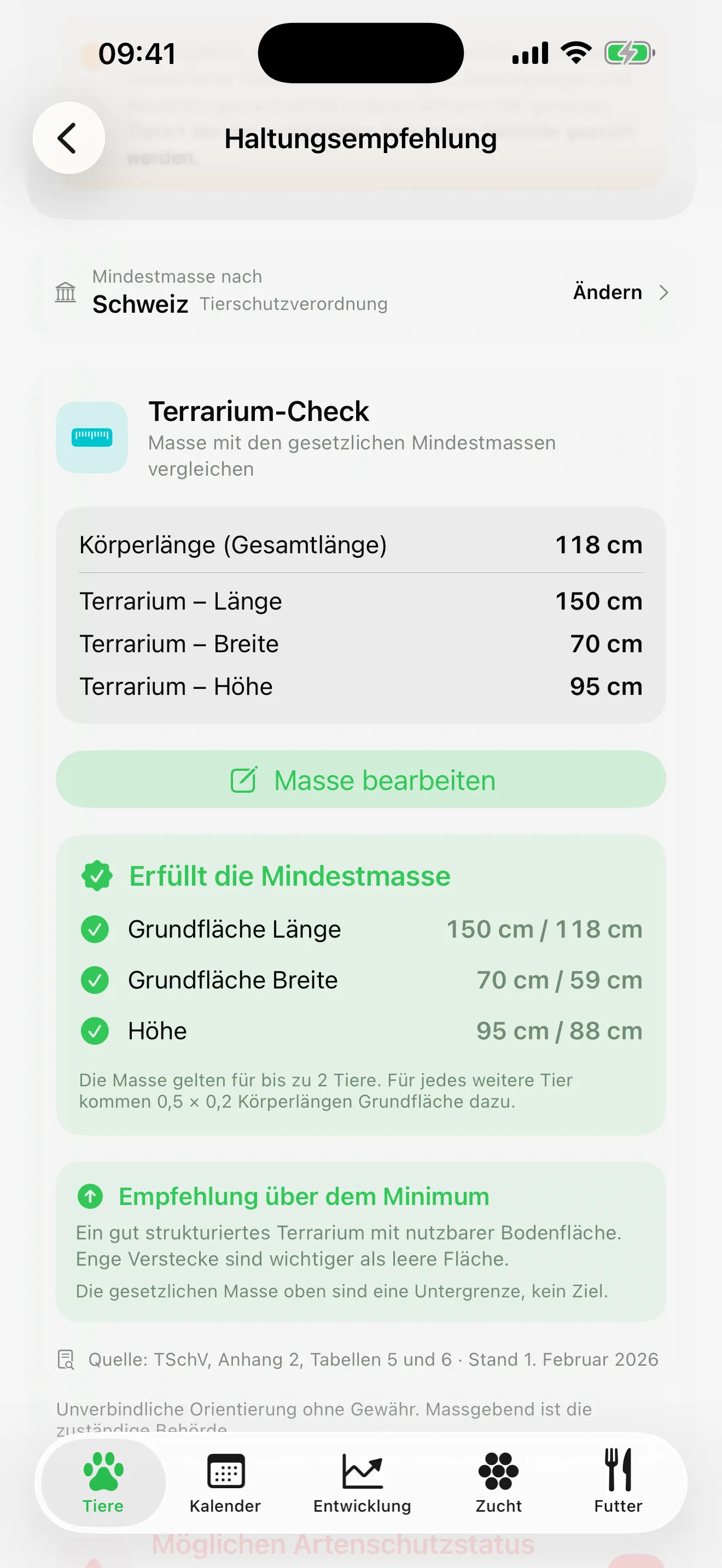
TSchV check (checking the terrarium size against the Animal Welfare Ordinance)
You enter the body length and internal dimensions, ReptiCare compares them with the derived minimums and shows green, amber or red. Amber means: right on the limit. The calculation is deliberately conservative: The light shows “too small” rather than falsely “compliant”.
Legal notes per species
For many species the app records whether a permit requirement, a training requirement or CITES status is to be expected: Together with a note on which documents to keep.
Documents together
Purchase contract, proof of origin and vet reports stay with the animal. A PDF dossier for the veterinary office can be generated from them.
Care you can prove
Feedings, weighings, sheds and cleanings are recorded with a date. At an inspection that is worth more than any memory.
Commonly kept species at a glance
For the species ReptiCare holds a classification for, this table summarises what to expect. It does not replace a case-by-case check: The details come from the app’s data and serve as orientation. Species without a stored profile are deliberately absent rather than guessed at.
| Species | Keeping permit | Expertise | Species protection |
|---|---|---|---|
| African house snake Boaedon fuliginosus | not required | not required | no species protection papers |
| California kingsnake Lampropeltis californiae | not required | not required | no species protection papers |
| Kenyan sand boa Eryx colubrinus | not required | not required | papers required (CITES) |
| Corn snake Pantherophis guttatus | not required | not required | no species protection papers |
| Ball python Python regius | not required | not required | papers required (CITES) |
| Black kingsnake Lampropeltis nigra | not required | not required | no species protection papers |
| Common garter snake Thamnophis sirtalis | not required | not required | no species protection papers |
| Amur rat snake Elaphe schrenckii | not required | not required | no species protection papers |
| Blood python Python brongersmai | not required | not required | papers required (CITES) |
| Boa constrictor | not required | not required | papers required (CITES) |
Show all 93 species
| Species | Keeping permit | Expertise | Species protection |
|---|---|---|---|
| Sumatran short-tailed python Python curtus | not required | not required | papers required (CITES) |
| Mexican kingsnake Lampropeltis mexicana | not required | not required | no species protection papers |
| Milk snake Lampropeltis triangulum | not required | not required | no species protection papers |
| Beauty rat snake Elaphe taeniura | not required | not required | no species protection papers |
| Carpet python Morelia spilota | not required | not required | papers required (CITES) |
| Western hognose snake Heterodon nasicus | not required | not required | no species protection papers |
| Javelin sand boa Eryx jaculus | not required | not required | papers required (CITES) |
| Western diamondback rattlesnake Crotalus atrox | required | required | no species protection papers |
| Burmese python Python bivittatus | required | required | papers required (CITES) |
| Amazon tree boa Corallus hortulanus | not required | not required | papers required (CITES) |
| Emerald tree boa Corallus caninus | not required | not required | papers required (CITES) |
| Green tree python Morelia viridis | not required | not required | papers required (CITES) |
| Madagascar tree boa Sanzinia madagascariensis | not required | not required | papers required (CITES) |
| Mandarin rat snake Euprepiophis mandarinus | not required | not required | no species protection papers |
| Reticulated python Malayopython reticulatus | required | required | papers required (CITES) |
| Central bearded dragon Pogona vitticeps | not required | not required | no species protection papers |
| Blue-tongued skink Tiliqua scincoides | not required | not required | papers required (CITES) |
| Green iguana Iguana iguana | required | required | papers required (CITES) |
| Crested gecko Correlophus ciliatus | not required | not required | no species protection papers |
| Leopard gecko Eublepharis macularius | not required | not required | no species protection papers |
| Veiled chameleon Chamaeleo calyptratus | required | required | papers required (CITES) |
| Panther chameleon Furcifer pardalis | required | required | papers required (CITES) |
| Hermann's tortoise Testudo hermanni | not required | not required | papers required (CITES) |
| Greek tortoise Testudo graeca | not required | not required | papers required (CITES) |
| Red-eared slider Trachemys scripta elegans | prohibited (Release Ordinance) | not required | no species protection papers |
| Axolotl Ambystoma mexicanum | not required | not required | papers required (CITES) |
| Chilean rose tarantula Grammostola rosea | not required | not required | papers required (CITES) |
| Mexican red-knee tarantula Brachypelma smithi | not required | not required | papers required (CITES) |
| Curly hair tarantula Tliltocatl albopilosus | not required | not required | papers required (CITES) |
| Antilles pinktoe tarantula Caribena versicolor | not required | not required | papers required (CITES) |
| Greenbottle blue tarantula Chromatopelma cyaneopubescens | not required | not required | no species protection papers |
| Indian ornamental tarantula Poecilotheria regalis | not required | not required | papers required (CITES) |
| Rankin's dragon Pogona henrylawsoni | not required | not required | no species protection papers |
| Green anole Anolis carolinensis | not required | not required | no species protection papers |
| Common collared lizard Crotaphytus collaris | not required | not required | no species protection papers |
| Chinese water dragon Physignathus cocincinus | not required | not required | papers required (CITES) |
| Saharan spiny-tailed lizard Uromastyx geyri | not required | not required | papers required (CITES) |
| Ridge-tailed monitor Varanus acanthurus | not required | not required | papers required (CITES) |
| Gargoyle gecko Rhacodactylus auriculatus | not required | not required | no species protection papers |
| African fat-tailed gecko Hemitheconyx caudicinctus | not required | not required | no species protection papers |
| Tokay gecko Gekko gecko | not required | not required | papers required (CITES) |
| New Caledonian giant gecko Rhacodactylus leachianus | not required | not required | no species protection papers |
| Marginated tortoise Testudo marginata | not required | not required | papers required (CITES) |
| Horsfield's tortoise Testudo horsfieldii | not required | not required | papers required (CITES) |
| Common musk turtle Sternotherus odoratus | not required | not required | papers required (CITES) |
| Reeves' turtle Mauremys reevesii | not required | not required | papers required (CITES) |
| Ornate horned frog Ceratophrys ornata | not required | not required | no species protection papers |
| Cranwell's horned frog Ceratophrys cranwelli | not required | not required | no species protection papers |
| White's tree frog Litoria caerulea | not required | not required | no species protection papers |
| Oriental fire-bellied toad Bombina orientalis | not required | not required | no species protection papers |
| Chinese fire-bellied newt Cynops orientalis | not required | not required | no species protection papers |
| Brazilian rainbow boa Epicrates cenchria | not required | not required | papers required (CITES) |
| Gopher snake Pituophis catenifer | not required | not required | no species protection papers |
| Gold dust day gecko Phelsuma laticauda | not required | not required | papers required (CITES) |
| Giant day gecko Phelsuma grandis | not required | not required | papers required (CITES) |
| Neon day gecko Phelsuma klemmeri | not required | not required | papers required (CITES) |
| Yellow-banded poison dart frog Dendrobates leucomelas | not required | not required | papers required (CITES) |
| Dyeing poison dart frog Dendrobates tinctorius | not required | not required | papers required (CITES) |
| Mimic poison dart frog Ranitomeya imitator | not required | not required | papers required (CITES) |
| Red-eyed tree frog Agalychnis callidryas | not required | not required | papers required (CITES) |
| Red-footed tortoise Chelonoidis carbonarius | not required | not required | papers required (CITES) |
| Painted turtle Chrysemys picta | not required | not required | no species protection papers |
| Schneider's skink Eumeces schneiderii | not required | not required | no species protection papers |
| Fire skink Mochlus fernandi | not required | not required | no species protection papers |
| Western rat snake Pantherophis obsoletus | not required | not required | no species protection papers |
| Savannah monitor Varanus exanthematicus | required | required | papers required (CITES) |
| Argentine black and white tegu Salvator merianae | required | required | papers required (CITES) |
| False tomato frog Dyscophus guineti | not required | not required | papers required (CITES) |
| Tomato frog Dyscophus antongilii | not required | not required | papers required (CITES) |
| African clawed frog Xenopus laevis | not required | not required | no species protection papers |
| Sarasin's giant gecko Correlophus sarasinorum | not required | not required | no species protection papers |
| African spurred tortoise Centrochelys sulcata | required | required | papers required (CITES) |
| Gila monster Heloderma suspectum | required | required | papers required (CITES) |
| Carpet chameleon Furcifer lateralis | required | required | papers required (CITES) |
| Bearded pygmy chameleon Rieppeleon brevicaudatus | required | required | papers required (CITES) |
| Emperor scorpion Pandinus imperator | not required | not required | papers required (CITES) |
| Asian forest scorpion Heterometrus spinifer | not required | not required | no species protection papers |
| African mantis Sphodromantis lineola | not required | not required | no species protection papers |
| Orchid mantis Hymenopus coronatus | not required | not required | no species protection papers |
| European mantis Mantis religiosa | not required | not required | no species protection papers |
| Macleay's spectre Extatosoma tiaratum | not required | not required | no species protection papers |
| Philippine leaf insect Phyllium philippinicum | not required | not required | no species protection papers |
| Indian stick insect Carausius morosus | not required | not required | no species protection papers |
Even where no permit is required, the minimum requirements of Annex 2 apply in full. Details per species on the Species pages.
If you want to know which species actually falls under which rule, the lists are under Reptiles and the law: permit-free, permit-required, banned and protected, species by species.
Sources and further contacts
- Animal Welfare Ordinance (TSchV, SR 455.1) on Fedlex
- FSVO: Legislation on animals
- sara-ch: Competence in reptiles and amphibians, Switzerland
- Foundation for the Animal in the Law: Keeping reptiles and amphibians
- Cantonal veterinary office: Responsible for permits, inspections and binding information.
Editorial status of this page: 18 August 2026. No warranty as to completeness, currency or applicability to an individual case.
