
SpeciesAfrican spurred tortoise
African spurred tortoise
Centrochelys sulcata
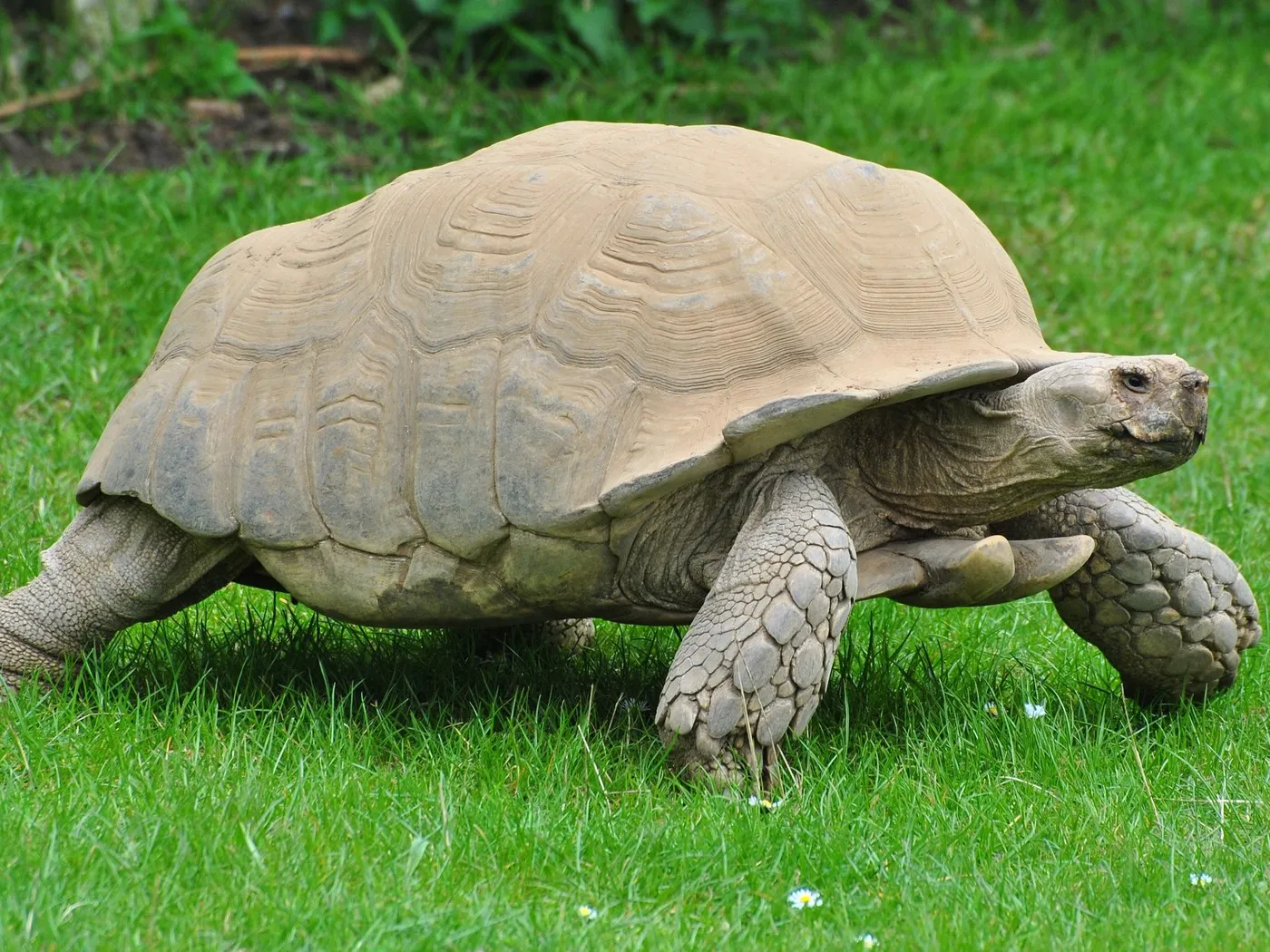
The third-largest tortoise in the world: A 5 cm hatchling becomes an animal with a 60 to 80 cm carapace that lives for decades and needs warmth all year round. Requires a permit in Switzerland.
- Group
- Tortoise or turtle
- Level
- Advanced
- Origin
- Africa
Where the species comes from
- World region
- Africa
- Countries
- The Sahel on the southern edge of the Sahara, from Senegal and Mauritania via Mali, Niger and Chad to Sudan, Eritrea and Ethiopia
- Habitat
- Dry, semi-desert grassland, bush and acacia savannah; retreats into burrows it digs itself
The app does not yet hold an origin entry for this species. The distribution given here comes from the specialist literature.
The natural habitat is the yardstick for how you furnish an enclosure. Knowing where an animal comes from is knowing why it needs heat zones, hides and a particular humidity.
Husbandry at a glance
The same details appear in the animal’s profile inside the app.
- Enclosure
- For up to two animals the Animal Welfare Ordinance requires an indoor enclosure of at least 8 × 4 carapace lengths: 320 × 160 cm for a carapace of 40 cm, 480 × 240 cm for 60 cm, 640 × 320 cm for 80 cm. In summer, add a large, escape-proof outdoor enclosure for grazing and a heated, insulated shelter.
- Temperature
- Basking spot locally up to about 45 °C, at least 23–26 °C in the enclosure during the day, not below 16 °C at night.
- Humidity
- Dry, about 40–50 %. Cold and damp together cause illness.
- Lighting
- As much sun as possible. Indoors, strong UVB and bright lamps (HQL, HQI or comparable) above the basking spot.
- Substrate
- Dry soil suitable for digging. Outdoors, natural ground with grass.
- Furnishings
- Heated shelter with a basking spot, hides, an opaque and sturdy enclosure wall. Nothing the animal can climb up and tip over on: Adults can hardly right themselves when on their back.
- Water
- A heavy, shallow water dish the animal cannot tip over. Bathe young animals regularly in lukewarm water.
- Feeding
- Grasses and hay as the main food (about 85 %), plus wild plants such as dandelion, plantain and clover, and opuntia. No fruit, no animal protein, no cabbage, no spinach. Do not overfeed, and offer extra calcium.
- Behaviour
- Diurnal, in the heat mostly active in the morning and evening. In the wild it digs burrows several metres long and retreats underground in great heat. Very strong: Weak barriers get dug under or pushed aside.
- Handling
- Only for checks and weighing. Adults weigh 45 to over 80 kg: Carrying them and vet visits take two people.
- Cohabitation
- Keeping several together is possible but needs a great deal of space: Males fight each other by ramming and biting and harass females during mating, sometimes causing serious injuries. For several animals the Animal Welfare Ordinance requires an enclosure that can be divided or a separate enclosure.
- Health
- Growing too fast on protein-rich or excessive food deforms the shell and bones. Cold, damp conditions lead to respiratory infections and shell rot.
- Seasonal cycle
- No hibernation: The species comes from the Sahel, where it sits out the hot dry season in its burrow. In Switzerland, outdoor enclosure only in the summer months; the rest of the time in the heated shelter or indoor enclosure.
- Safety
- Requires a permit under Art. 89 of the Ordinance, plus CITES papers. Buying one is a commitment for decades: In captivity, African spurred tortoises live beyond 50 years.
Legal position in Switzerland
Permit required
Requires a permit. Art. 89 let. f of the Ordinance expressly names the African spurred tortoise (Geochelone [Centrochelys] sulcata), and Annex 2, Table 5 lists it under item 2 with the note that private keeping requires a permit. The cantonal veterinary office issues the permit before acquisition. It requires an expert report by an independent, recognised specialist confirming that the planned enclosures and facilities allow animal-appropriate keeping (Art. 92 para. 1 let. h of the Ordinance); the applicant and the authority choose the specialist together
Training required
Certificate of competence under Art. 85 para. 3 let. c of the Ordinance required. That provision excludes giant tortoises and sea turtles; the Ordinance, however, lists the African spurred tortoise separately from the giant tortoises, and the FSVO has recognised a certificate of competence specifically for African spurred tortoises. The FSVO confirms this in its technical information 13.2 on training requirements: it requires further training only for crocodiles, giant tortoises and sea turtles, not for the African spurred tortoise
Species protection applies
CITES Appendix II (Washington Convention). In Switzerland you need papers for every animal that prove its origin and lawful acquisition. They go with the animal when you pass it on (Art. 10 BGCITES). Anyone offering the animal publicly states the CITES appendix, the scientific name and whether it comes from captive breeding or the wild (Art. 7a VCITES). Switzerland has no general marking requirement. The EU lists the species in Annex B
Minimum enclosure dimensions
Annex 2, table 5 of the Animal Welfare Ordinance does not prescribe centimetres but multiples of body length. For this species, item 2 (African spurred tortoise): floor area 8 × 4 body lengths. The floor area applies to at most two animals; each further animal requires an additional 2 × 2 body lengths.
For this group, body length means the carapace length, measured in a straight line from the front to the rear edge of the shell, not over the curve. The largest animal in the enclosure is what counts. The enclosure may not be smaller even if fewer animals live in it than the table names.
| Carapace length | At least |
|---|---|
| 40 cm | 320 × 160 cm |
| 50 cm | 400 × 200 cm |
| 60 cm | 480 × 240 cm |
| 70 cm | 560 × 280 cm |
| 80 cm | 640 × 320 cm |
Animals may temporarily be kept in smaller enclosures: for quarantine, for the treatment of illness and injury, for acclimatisation, for breeding and rearing, and for winter or cold dormancy or aestivation (preliminary remark D on reptiles).
This is the legal lower limit, not a recommendation. An enclosure that meets exactly these dimensions is permitted, but not good for that reason. The details under “Husbandry at a glance” work out this minimum for adult animals; they give the minimum, not the ideal.
What the enclosure must provide
For item 2, Annex 2, Table 5 of the Ordinance also requires: Access to the outdoors as long as the weather allows; a temperature suited to the animals’ needs with a heat source; ground that can partly be dug in; hides; a solid enclosure construction; bright lamps (HQL, HQI or comparable) for the basking spot, unless kept outdoors or in direct sun. If several animals live together, the enclosure must be divisible or a separate enclosure must be available. The social structure must be respected.
Paperwork
Keep the keeping permit, certificate of competence, purchase contract and an unbroken proof of origin. For CITES-protected species, the required CITES documents and species protection checks apply to every border crossing.
These details are a guide, not legal advice. Binding information comes from the cantonal veterinary office; the text of the ordinance is what counts. More on the legal position

_(8679964197).jpg)