
SpeciesGopher snake
Gopher snake
Pituophis catenifer
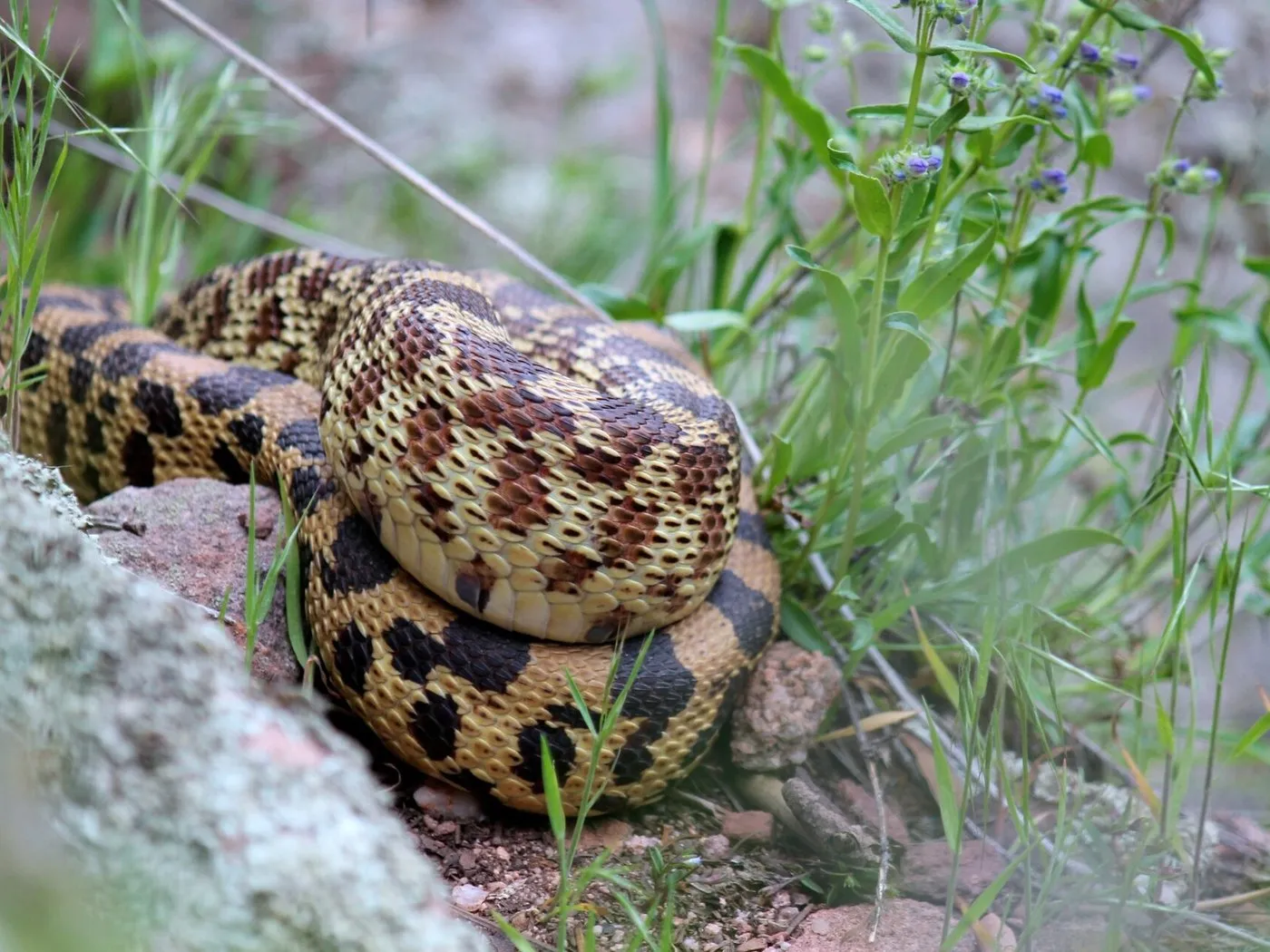
A powerful, burrowing snake that hisses loudly and vibrates its tail when disturbed: A rattlesnake impression with no danger at all. It feeds readily and grows large.
- Group
- Snake
- Level
- Intermediate
- Origin
- North America
Where the species comes from
- World region
- North America
- Countries
- Western United States, south-western Canada and northern Mexico
- Habitat
- Dry grasslands, semi-deserts and open woodland
The app does not yet hold an origin entry for this species. The distribution given here comes from the specialist literature.
The natural habitat is the yardstick for how you furnish an enclosure. Knowing where an animal comes from is knowing why it needs heat zones, hides and a particular humidity.
Husbandry at a glance
The same details appear in the animal’s profile inside the app.
- Enclosure
- A spacious, escape-proof enclosure. The Animal Welfare Ordinance sets no minimum size for gopher snakes. The reference is the German 1997 expert report on reptile keeping: at least 1 × 0.5 × 0.75 body lengths, i.e. 180 × 90 × 135 cm for a total length of 180 cm.
- Temperature
- Warm side 30 °C, cool side 22–24 °C, 20 °C at night.
- Humidity
- 40–50 %, with a moist hide for shedding.
- Lighting
- Weak UV-B is beneficial.
- Substrate
- Deep substrate that allows digging.
- Furnishings
- At least two hides, climbing branches, stable stones.
- Water
- Large dish.
- Feeding
- One appropriately sized rodent every ten to fourteen days.
- Behaviour
- Diurnal, digs a lot. The hissing and tail vibration are a threat display, not an attack.
- Handling
- Quite possible; the animals get used to it quickly.
- Cohabitation
- Kept singly.
- Health
- Robust. Obesity from feeding too often.
- Seasonal cycle
- Winter rest of two to three months at 12–15 °C.
- Safety
- Non-venomous, no permit required.
Legal position in Switzerland
No permit foreseen
No permit required. The genus is on the list of harmless venomous snakes in the federal veterinary office’s ordinance on keeping wild animals (SR 455.110.3) and is therefore exempt from the permit requirement under Art. 89 let. h of the Ordinance
No certificate of competence foreseen
No proof of competence required. It is only demanded for the animals named in Art. 89 of the Ordinance
No CITES listing
Not listed in the CITES appendices: Import and transfer require no species-protection papers. Keep the proof of purchase nonetheless
Minimum enclosure dimensions
Annex 2, table 5 of the Animal Welfare Ordinance does not list this species. Among snakes the table names only giant snakes (pythons and boas), elapids, vipers and pit vipers, and a few venomous or dangerous colubrids; for the rest no figure appears there.
The general rule in Annex 2 (letter K) then applies: the enclosure must be large enough for everything the species needs (hides, basking spot, climbing branches) to be arranged sensibly. As a yardstick, the ordinance points to expert opinions on a scientific basis. There is therefore no binding figure. The guide values in the calculator come from the 1997 expert report. Binding information comes from the cantonal veterinary office.
What the enclosure must provide
Provide species-appropriate heat and light zones, UV-B where needed, suitable substrate, retreats, climbing or digging options, water and natural rest periods.
Paperwork
Keep the purchase contract and proof of origin. Use the scientific name to check CITES and import status reliably.
These details are a guide, not legal advice. Binding information comes from the cantonal veterinary office; the text of the ordinance is what counts. More on the legal position

