
SpeciesAfrican mantis
African mantis
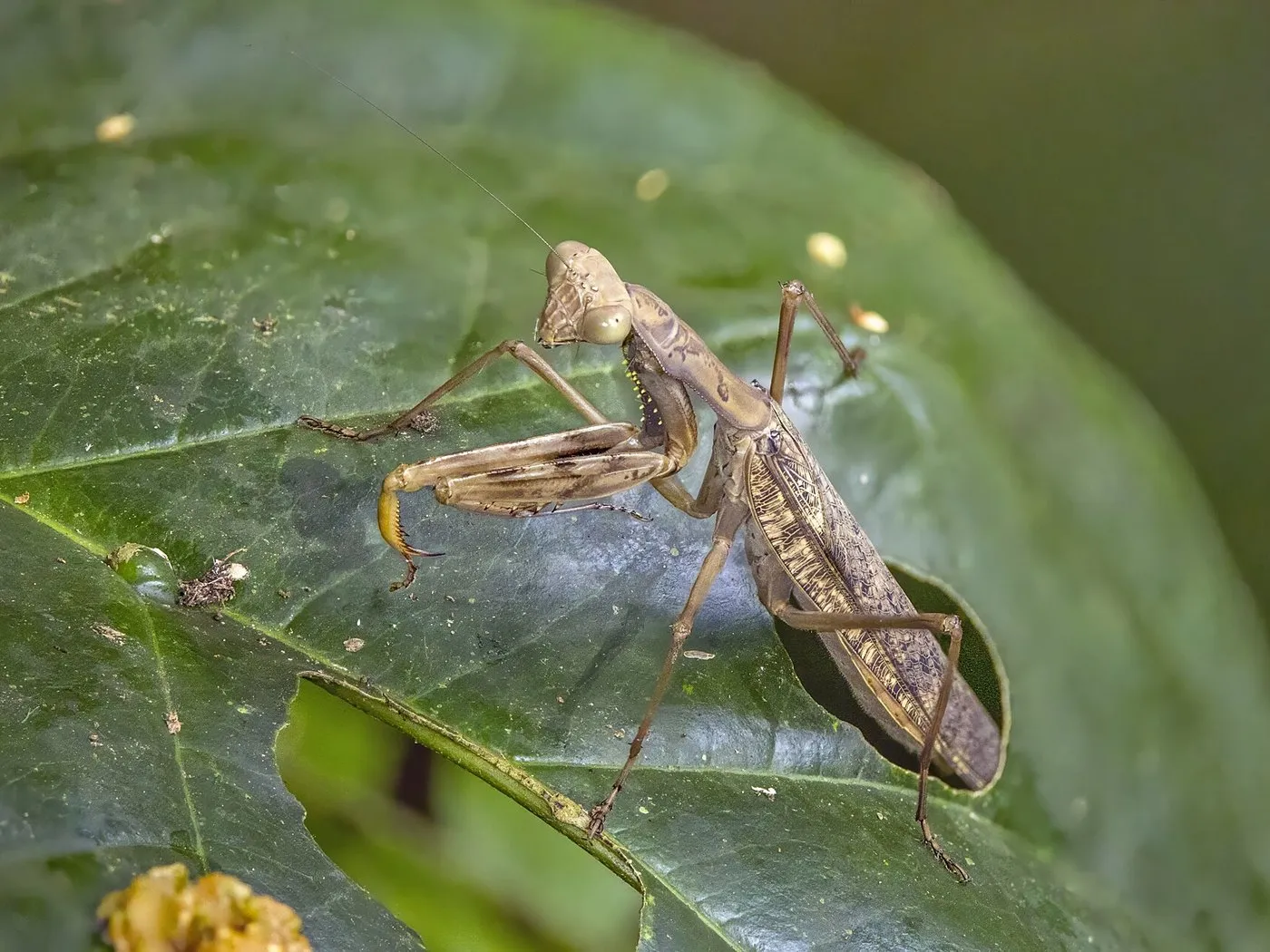
Sphodromantis lineola
The usual beginner species: large, robust and with a good appetite. A mantis lives only about a year, though. Anyone looking for a long-lived animal is in the wrong place.
- Group
- Mantis
- Level
- Beginner
- Origin
- Africa
Where the species comes from
- World region
- Africa
- Countries
- West and Central Africa
- Habitat
- Bushland and savannah
The app does not yet hold an origin entry for this species. The distribution given here comes from the specialist literature.
The natural habitat is the yardstick for how you furnish an enclosure. Knowing where an animal comes from is knowing why it needs heat zones, hides and a particular humidity.
Husbandry at a glance
The same details appear in the animal’s profile inside the app.
- Enclosure
- 20 × 20 × 30 cm for one animal. The height must be at least three times the body length, otherwise moulting fails.
- Temperature
- 25–30 °C by day, 20 °C at night.
- Humidity
- 50–60 %, mist every two days.
- Lighting
- No special lighting needed.
- Substrate
- Coco humus, which holds the moisture.
- Furnishings
- Twigs and mesh surfaces to hang from. To moult the animal hangs upside down and needs free space beneath it.
- Water
- Droplets on the walls after misting.
- Feeding
- One appropriately sized insect every two to three days. Live food is essential; dead prey is refused.
- Behaviour
- Diurnal, lying in wait motionless, striking at lightning speed.
- Handling
- Possible, but the animals are fragile.
- Cohabitation
- Alone. Conspecifics are eaten.
- Health
- Failed moults caused by enclosures that are too low are the leading cause of death.
- Seasonal cycle
- No rest period. Life expectancy is about one year.
- Safety
- No permit required. Never release into the wild.
Legal position in Switzerland
No permit foreseen
No permit required. The species does not belong to any of the groups listed in Art. 89 of the Swiss Animal Welfare Ordinance
No certificate of competence foreseen
No proof of competence required. It is only demanded for the animals named in Art. 89 of the Ordinance
No CITES listing
Not listed in the CITES appendices: Import and transfer require no species-protection papers. Keep the proof of purchase nonetheless
Minimum enclosure dimensions
The Animal Welfare Ordinance does not apply to these animals: under Art. 1 it governs the handling of vertebrates, cephalopods and reptant decapods. There are therefore no minimum dimensions. Housing, climate and places to retreat should still match the needs of the species. The cantonal veterinary office can say whether cantonal rules apply, for example to venomous animals.
What the enclosure must provide
Escape-proof closure, humidity and temperature suited to the species, a hide and climbing structure.
Paperwork
Keep a receipt bearing the scientific name. Never release invertebrates into the wild: Even seemingly harmless species can establish themselves.
These details are a guide, not legal advice. Binding information comes from the cantonal veterinary office; the text of the ordinance is what counts. More on the legal position

_Nyamebe_Bepo.jpg)