
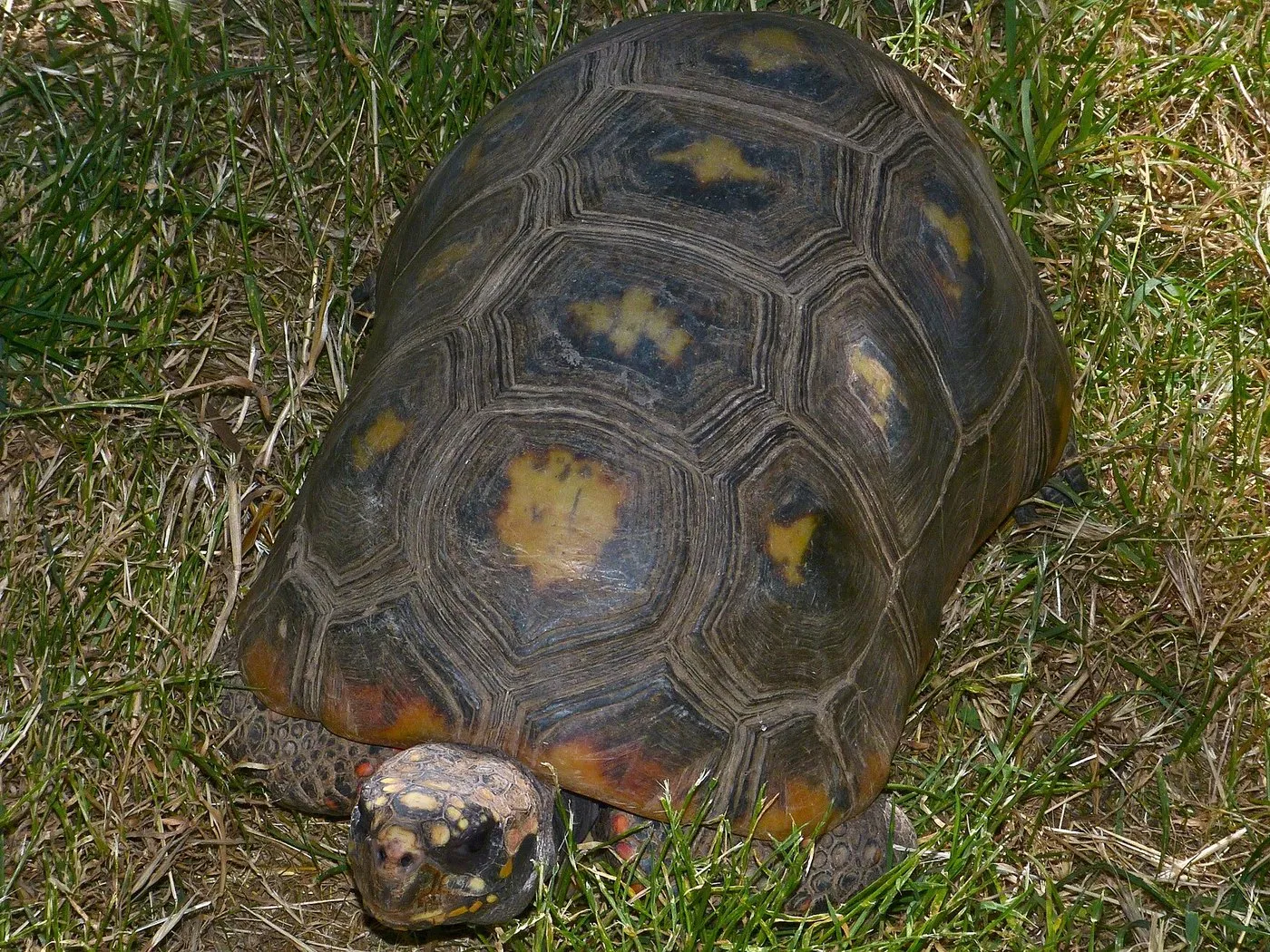
SpeciesRed-footed tortoise
Red-footed tortoise
Chelonoidis carbonarius
The most common tropical tortoise in the trade and kept quite differently from the European species: warm and humid all year, without hibernation.
- Group
- Tortoise or turtle
- Level
- Intermediate
- Origin
- South America
Where the species comes from
- World region
- South America
- Countries
- Panama, northern and central South America to northern Argentina
- Habitat
- Humid savannahs and forest edges
The app does not yet hold an origin entry for this species. The distribution given here comes from the specialist literature.
The natural habitat is the yardstick for how you furnish an enclosure. Knowing where an animal comes from is knowing why it needs heat zones, hides and a particular humidity.
Husbandry at a glance
The same details appear in the animal’s profile inside the app.
- Enclosure
- For up to two animals the Animal Welfare Ordinance requires an indoor enclosure of at least 8 × 4 carapace lengths: 240 × 120 cm for a carapace of 30 cm, 320 × 160 cm for 40 cm, 400 × 200 cm for 50 cm. The ordinance sets not only the area but also the ratio of length to width. In summer an outdoor enclosure with a shelter.
- Temperature
- Basking spot at 35 °C, ambient 26–30 °C, not below 22 °C at night.
- Humidity
- 70–80 %. Unlike the European species, humidity is essential here.
- Lighting
- Strong UV-B for twelve hours.
- Substrate
- Deep, moist soil-bark mix with leaf litter.
- Furnishings
- Large hides, plants, a moist retreat corner.
- Water
- Shallow basin for drinking and bathing, refreshed daily.
- Feeding
- Mainly herbs, leaves and fungi, plus fruit and, every two weeks, some animal protein: Unlike the European species, it belongs in the diet.
- Behaviour
- Diurnal, calm, not shy.
- Handling
- Only for checks and weighing.
- Cohabitation
- Alone or several females given plenty of space. If a male harasses the females constantly — persistent mounting, biting, no way to get away — castration is, from an animal welfare point of view, a better solution than separation in a confined space. The procedure belongs in the hands of a vet experienced with reptiles; it takes away the pressure to breed, not the animal's character. This recommendation comes from Zürcher Tierschutz.
- Health
- A lumpy shell from rearing too dry; respiratory infections in the cold.
- Seasonal cycle
- No hibernation: The species comes from the tropics. Keep warm all year.
- Safety
- No keeping permit required, but CITES papers and proof of origin.
Legal position in Switzerland
No permit foreseen
No permit required. The species does not belong to any of the groups listed in Art. 89 of the Swiss Animal Welfare Ordinance
No certificate of competence foreseen
No proof of competence required. It is only demanded for the animals named in Art. 89 of the Ordinance
Species protection applies
CITES Appendix II: Import and transfer only with papers. When buying, ask for proof of origin and captive breeding
Minimum enclosure dimensions
Annex 2, table 5 of the Animal Welfare Ordinance does not prescribe centimetres but multiples of body length. For this species, item 3 (Tropical and subtropical tortoises): floor area 8 × 4 body lengths. The floor area applies to at most two animals; each further animal requires an additional 2 × 2 body lengths.
For this group, body length means the carapace length, measured in a straight line from the front to the rear edge of the shell, not over the curve. The largest animal in the enclosure is what counts. The enclosure may not be smaller even if fewer animals live in it than the table names.
| Carapace length | At least |
|---|---|
| 25 cm | 200 × 100 cm |
| 30 cm | 240 × 120 cm |
| 40 cm | 320 × 160 cm |
| 50 cm | 400 × 200 cm |
Animals may temporarily be kept in smaller enclosures: for quarantine, for the treatment of illness and injury, for acclimatisation, for breeding and rearing, and for winter or cold dormancy or aestivation (preliminary remark D on reptiles).
This is the legal lower limit, not a recommendation. An enclosure that meets exactly these dimensions is permitted, but not good for that reason. The details under “Husbandry at a glance” work out this minimum for adult animals; they give the minimum, not the ideal.
What the enclosure must provide
Provide species-appropriate heat and light zones, UV-B where needed, suitable substrate, retreats, climbing or digging options, water and natural rest periods.
Paperwork
Ask for proof of origin and CITES papers and keep them for life.
These details are a guide, not legal advice. Binding information comes from the cantonal veterinary office; the text of the ordinance is what counts. More on the legal position

_(9194511084).jpg)