
SpeciesOriental fire-bellied toad
Oriental fire-bellied toad
Bombina orientalis
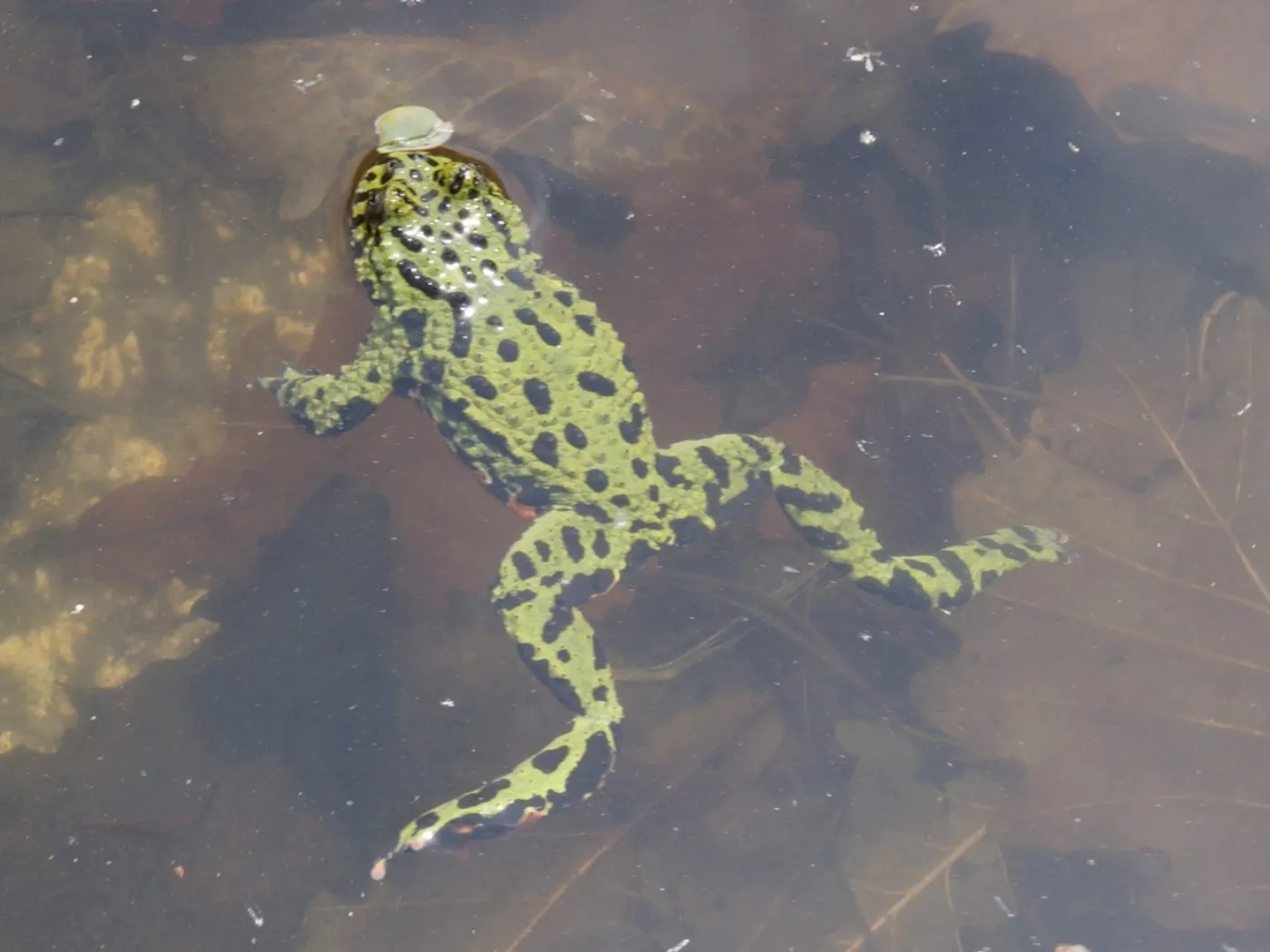
Small, active by day and kept in groups. One of the few amphibians where there is actually something to see in the tank. When threatened it shows its bright red belly.
- Group
- Amphibian
- Level
- Beginner
- Origin
- East Asia
Where the species comes from
- World region
- East Asia
- Countries
- North-eastern China, Korea and south-eastern Russia
- Habitat
- Shallow ponds, ditches and rice paddies
The app does not yet hold an origin entry for this species. The distribution given here comes from the specialist literature.
The natural habitat is the yardstick for how you furnish an enclosure. Knowing where an animal comes from is knowing why it needs heat zones, hides and a particular humidity.
Husbandry at a glance
The same details appear in the animal’s profile inside the app.
- Enclosure
- 80 × 40 × 40 cm for a group, roughly half water, half land.
- Temperature
- 20–24 °C by day, cooler at night. Heat above 26 °C is poorly tolerated.
- Humidity
- High, an aqua-terrarium.
- Lighting
- Weak UV-B is beneficial, twelve hours.
- Substrate
- Gravel in the water, soil and moss on land.
- Furnishings
- A gentle transition between water and land, water plants, pieces of bark.
- Water
- Water section 10–15 cm deep, a filter or frequent changes. Clean water is decisive.
- Feeding
- Small insects several times a week.
- Behaviour
- Diurnal, swims and calls. When threatened it adopts a warning posture with an arched back.
- Handling
- Do not handle. The skin secretion irritates mucous membranes; wash your hands after working in the tank.
- Cohabitation
- Group keeping from four animals upwards.
- Health
- Robust when kept cool with clean water.
- Seasonal cycle
- Winter rest at 8–12 °C for two to three months.
- Safety
- No permit required. Never release into the wild: The species can transmit diseases to native amphibians.
Legal position in Switzerland
No permit foreseen
No permit required. The species does not belong to any of the groups listed in Art. 89 of the Swiss Animal Welfare Ordinance
No certificate of competence foreseen
No proof of competence required. It is only demanded for the animals named in Art. 89 of the Ordinance
No CITES listing
Not listed in the CITES appendices: Import and transfer require no species-protection papers. Keep the proof of purchase nonetheless
Minimum enclosure dimensions
Annex 2, table 6 of the Animal Welfare Ordinance, the table for amphibians, does not list this species. The table is arranged by family and distinguishes groups within each, mostly naming specific genera or species, for some items only as examples. Neither this species nor its genus appears there; the table sets no figure for it.
The general rule in Annex 2 (letter K) then applies: the enclosure must be large enough for everything the species needs (hides, basking spot, climbing branches) to be arranged sensibly. As a yardstick, the ordinance points to expert opinions on a scientific basis. There is therefore no binding figure. Binding information comes from the cantonal veterinary office.
What the enclosure must provide
Clean water with a shallow exit, a land section with a hide. Releasing is forbidden; imported amphibian diseases have already harmed native populations.
Paperwork
Keep the purchase contract and proof of origin. Use the scientific name to check CITES and import status reliably.
These details are a guide, not legal advice. Binding information comes from the cantonal veterinary office; the text of the ordinance is what counts. More on the legal position

