
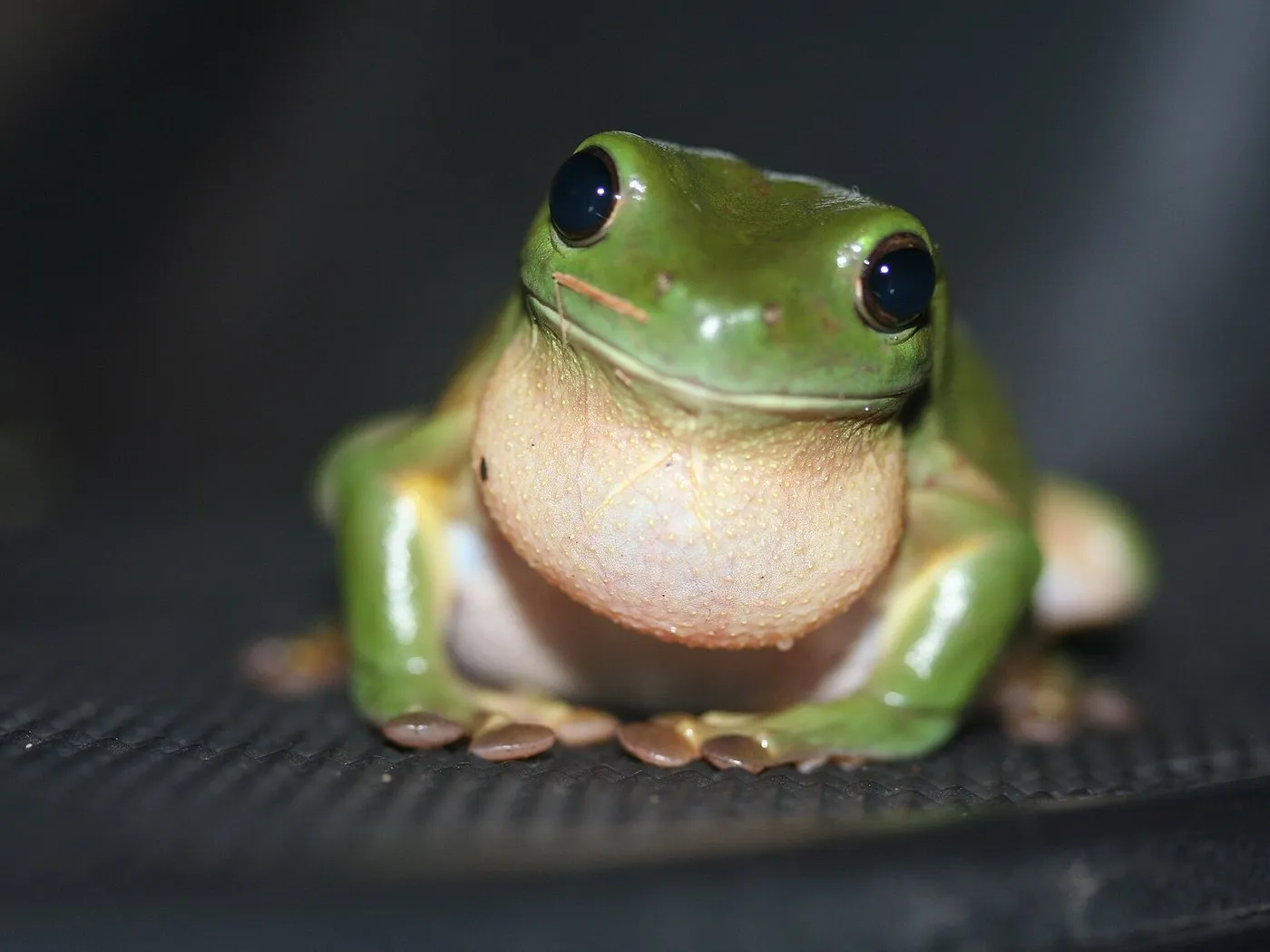
SpeciesWhite's tree frog
White's tree frog
Litoria caerulea
A large, calm tree frog with a permanently friendly expression. It lives up to twenty years and readily grows fat in captivity.
- Group
- Amphibian
- Level
- Beginner
- Origin
- Australia
Where the species comes from
- World region
- Australia
- Countries
- Northern and eastern Australia, southern New Guinea
- Habitat
- Humid forests and gardens, often near houses
The app does not yet hold an origin entry for this species. The distribution given here comes from the specialist literature.
The natural habitat is the yardstick for how you furnish an enclosure. Knowing where an animal comes from is knowing why it needs heat zones, hides and a particular humidity.
Husbandry at a glance
The same details appear in the animal’s profile inside the app.
- Enclosure
- 60 × 45 × 90 cm for two animals, height before floor area.
- Temperature
- 24–28 °C by day, 20–22 °C at night.
- Humidity
- 60–70 %, mist in the evening.
- Lighting
- Weak UV-B is beneficial, twelve hours.
- Substrate
- Coco humus with moss.
- Furnishings
- Sturdy horizontal branches, broad-leaved plants, cork tubes.
- Water
- A large shallow basin to sit in, refreshed daily.
- Feeding
- Insects two to three times a week, adults less often.
- Behaviour
- Nocturnal, calm, sits hunched during the day. Calls loudly before rain.
- Handling
- Only with moistened hands and rarely.
- Cohabitation
- Groups of equally sized animals are possible.
- Health
- Obesity is the most common problem; a frog should keep a visible waist.
- Seasonal cycle
- No winter rest: White's tree frog comes from northern Australia and New Guinea. A drier, cooler phase of six to eight weeks at 20–22 °C with much less misting matches the local dry season; afterwards, heavy misting initiates the mating season.
- Safety
- No permit required.
Legal position in Switzerland
No permit foreseen
No permit required. The species does not belong to any of the groups listed in Art. 89 of the Swiss Animal Welfare Ordinance
No certificate of competence foreseen
No proof of competence required. It is only demanded for the animals named in Art. 89 of the Ordinance
No CITES listing
Not listed in the CITES appendices: Import and transfer require no species-protection papers. Keep the proof of purchase nonetheless
Minimum enclosure dimensions
Annex 2, table 6 of the Animal Welfare Ordinance, the table for amphibians, does not list this species. The table is arranged by family and distinguishes groups within each, mostly naming specific genera or species, for some items only as examples. Neither this species nor its genus appears there; the table sets no figure for it.
The general rule in Annex 2 (letter K) then applies: the enclosure must be large enough for everything the species needs (hides, basking spot, climbing branches) to be arranged sensibly. As a yardstick, the ordinance points to expert opinions on a scientific basis. There is therefore no binding figure. Binding information comes from the cantonal veterinary office.
What the enclosure must provide
Provide species-appropriate heat and light zones, UV-B where needed, suitable substrate, retreats, climbing or digging options, water and natural rest periods.
Paperwork
Keep the purchase contract and proof of origin. Use the scientific name to check CITES and import status reliably.
These details are a guide, not legal advice. Binding information comes from the cantonal veterinary office; the text of the ordinance is what counts. More on the legal position

.jpg)