
SpeciesBeauty rat snake
Beauty rat snake
Elaphe taeniura
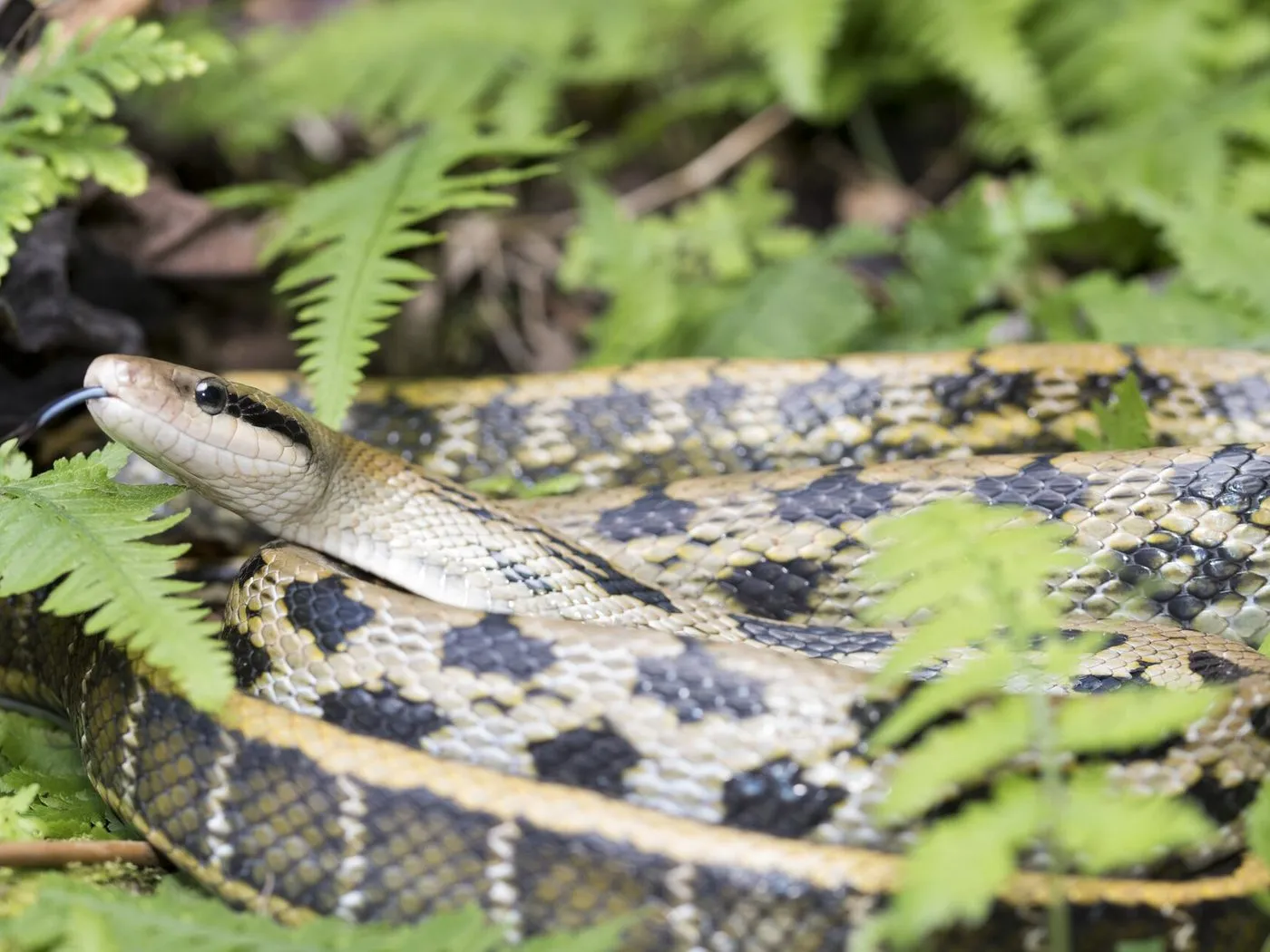
Very active, very fast and a keen climber. It needs a tall, spacious enclosure and knowledge of the subspecies to get the climate right.
- Group
- Snake
- Level
- Intermediate
- Origin
- South and East Asia
Where the species comes from
- World region
- South and East Asia
- Countries
- China, Taiwan, Vietnam, Thailand and Malaysia
- Habitat
- Forests, karst caves, rock formations and farmland
The app does not yet hold an origin entry for this species. The distribution given here comes from the specialist literature.
The natural habitat is the yardstick for how you furnish an enclosure. Knowing where an animal comes from is knowing why it needs heat zones, hides and a particular humidity.
Husbandry at a glance
The same details appear in the animal’s profile inside the app.
- Enclosure
- Very spacious and tall. The Animal Welfare Ordinance sets no minimum size for beauty snakes. The reference is the German 1997 expert report on reptile keeping: at least 1 × 0.5 × 1 body lengths, but no more than 2 m in height. Depending on the subspecies the animals reach 150 to 250 cm, i.e. 180 × 90 × 180 cm at 180 cm.
- Temperature
- Basking spot 28–30 °C, cool side 21–24 °C.
- Humidity
- Around 50–70 %.
- Lighting
- Bright daylight and UVB are advisable.
- Substrate
- A soil and bark mix.
- Furnishings
- A great many sturdy branches, platforms and hides.
- Water
- A large water bowl.
- Feeding
- Thawed rodents or birds.
- Behaviour
- Very active, fast and a keen climber.
- Handling
- Handle calmly and with plenty of room.
- Cohabitation
- Keep singly.
- Health
- Injuries, breathing, weight and mouth.
- Seasonal cycle
- Two to three months of winter rest at 12–15 °C for animals from the northern part of the range. Forms from South-East Asia do not need it; a slightly cooler, drier phase is enough there. Clarify subspecies and origin before cooling down.
- Safety
- The subspecies can change the climate requirements considerably.
Legal position in Switzerland
No permit foreseen
No permit required. The genus is on the list of harmless venomous snakes in the federal veterinary office’s ordinance on keeping wild animals (SR 455.110.3) and is therefore exempt from the permit requirement under Art. 89 let. h of the Ordinance
No certificate of competence foreseen
No proof of competence required. It is only demanded for the animals named in Art. 89 of the Ordinance
No CITES listing
Not listed in the CITES appendices: Import and transfer require no species-protection papers. Keep the proof of purchase nonetheless
Minimum enclosure dimensions
Annex 2, table 5 of the Animal Welfare Ordinance does not list this species. Among snakes the table names only giant snakes (pythons and boas), elapids, vipers and pit vipers, and a few venomous or dangerous colubrids; for the rest no figure appears there.
The general rule in Annex 2 (letter K) then applies: the enclosure must be large enough for everything the species needs (hides, basking spot, climbing branches) to be arranged sensibly. As a yardstick, the ordinance points to expert opinions on a scientific basis. There is therefore no binding figure. The guide values in the calculator come from the 1997 expert report. Binding information comes from the cantonal veterinary office.
What the enclosure must provide
Provide species-appropriate heat and light zones, UV-B where needed, suitable substrate, retreats, climbing or digging options, water and natural rest periods.
Paperwork
Keep the purchase contract and proof of origin. Use the scientific name to check CITES and import status reliably.
These details are a guide, not legal advice. Binding information comes from the cantonal veterinary office; the text of the ordinance is what counts. More on the legal position

