
SpeciesAntilles pinktoe tarantula
Antilles pinktoe tarantula
Caribena versicolor
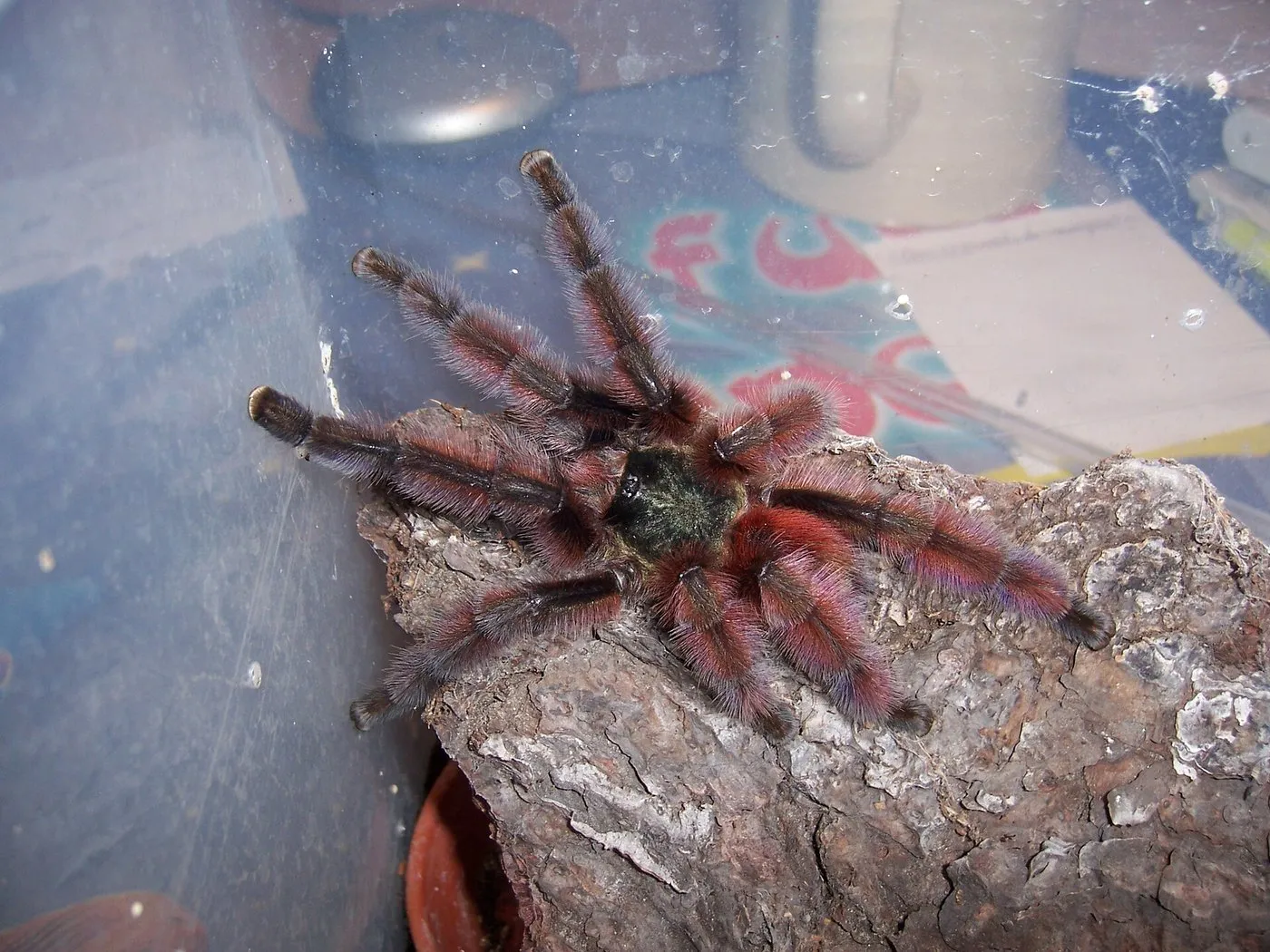
Juveniles are bright blue, adults shimmer green and red. The species is beautiful and popular, but it does not forgive poor ventilation, and that is where most beginners fail.
- Group
- Spider
- Level
- Intermediate
- Origin
- The Caribbean
Where the species comes from
- World region
- The Caribbean
- Countries
- Martinique (endemic)
- Habitat
- Humid mountain forests, silk retreats in tree hollows and bromeliads
The app does not yet hold an origin entry for this species. The distribution given here comes from the specialist literature.
The natural habitat is the yardstick for how you furnish an enclosure. Knowing where an animal comes from is knowing why it needs heat zones, hides and a particular humidity.
Husbandry at a glance
The same details appear in the animal’s profile inside the app.
- Enclosure
- Tree dweller. Height before floor area: 30 × 20 × 40 cm, with cross ventilation.
- Temperature
- 24–28 °C.
- Humidity
- 70–80 %, but with constant airflow. Humid and stuffy at once is fatal.
- Lighting
- No lighting needed, indirect daylight is enough.
- Substrate
- 5 cm, holds the moisture; the spider lives above it.
- Furnishings
- A vertical cork tube, climbing branches, plants. It builds a silken tube.
- Water
- Small water dish and misting of one side twice a week.
- Feeding
- Weekly, flying or climbing feeder insects.
- Behaviour
- Fast and quick to flee. It would rather leap away than defend itself.
- Handling
- Do not pick up: It is gone within seconds.
- Cohabitation
- Keep singly.
- Health
- Sensitive to waterlogging when there is too little air movement.
- Seasonal cycle
- No rest period.
- Safety
- Few urticating hairs, very fast. Only work with the lid closed.
Legal position in Switzerland
No permit foreseen
No permit required. The species does not belong to any of the groups listed in Art. 89 of the Swiss Animal Welfare Ordinance
No certificate of competence foreseen
No proof of competence required. It is only demanded for the animals named in Art. 89 of the Ordinance
Species protection applies
CITES Appendix III, listed by the European Union: Proof of origin belongs to the purchase. Appendix III asks less than Appendix II, but not nothing
Minimum enclosure dimensions
The Animal Welfare Ordinance does not apply to these animals: under Art. 1 it governs the handling of vertebrates, cephalopods and reptant decapods. There are therefore no minimum dimensions. Housing, climate and places to retreat should still match the needs of the species. The cantonal veterinary office can say whether cantonal rules apply, for example to venomous animals.
What the enclosure must provide
Escape-proof closure, humidity suited to the species, a retreat and water. Spiders are kept singly; most species eat their own kind.
Paperwork
Keep the proof of origin and hand it over when passing the animal on (Art. 10 of the CITES Act). Cantonal rules may apply to venomous animals: Check with the cantonal veterinary office before buying.
These details are a guide, not legal advice. Binding information comes from the cantonal veterinary office; the text of the ordinance is what counts. More on the legal position

