
SpeciesEuropean mantis
European mantis
Mantis religiosa
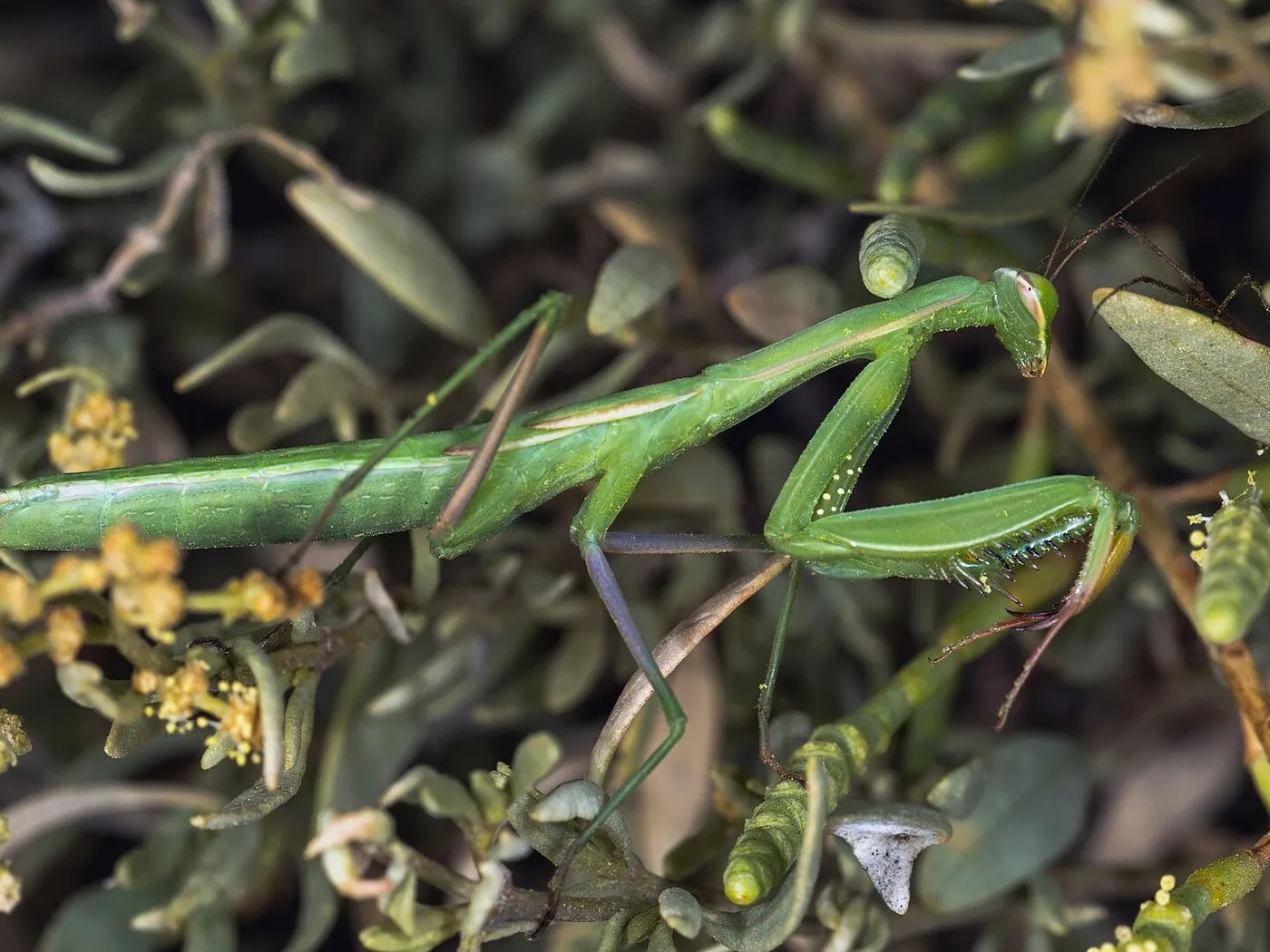
The only native mantis in Switzerland, mainly in Valais, Ticino and the Lake Geneva region. Precisely for that reason a rule applies to it that applies to no other species here.
- Group
- Mantis
- Level
- Beginner
- Origin
- Europe and Asia
Where the species comes from
- World region
- Europe and Asia
- Countries
- From southern Europe to Asia; in Switzerland Valais, Ticino and the Lake Geneva region
- Habitat
- Dry, sunny meadows and embankments
The app does not yet hold an origin entry for this species. The distribution given here comes from the specialist literature.
The natural habitat is the yardstick for how you furnish an enclosure. Knowing where an animal comes from is knowing why it needs heat zones, hides and a particular humidity.
Husbandry at a glance
The same details appear in the animal’s profile inside the app.
- Enclosure
- 20 × 20 × 30 cm for one animal.
- Temperature
- 22–28 °C by day, a night-time drop is desirable.
- Humidity
- 50–60 %, mist every two to three days.
- Lighting
- Bright, but no special equipment needed.
- Substrate
- Coco humus or sand.
- Furnishings
- Twigs and a mesh lid to hang from.
- Water
- Droplets on the walls.
- Feeding
- One insect every two to three days. Live food essential.
- Behaviour
- Diurnal, lying in wait motionless in the vegetation.
- Handling
- Possible, but unnecessary.
- Cohabitation
- Kept singly.
- Health
- Failed moults if the enclosure is too low.
- Seasonal cycle
- The egg cases overwinter cool; the adults die in autumn.
- Safety
- Protected in Switzerland as a native species: animals may not be taken from the wild. Only captive-bred individuals may be kept and they must not be released, not even where the species occurs.
Legal position in Switzerland
No permit foreseen
No permit under the Ordinance: It does not cover insects. As a native species it is however protected under nature conservation law: animals may not be taken from the wild. Only captive-bred individuals may be kept
No certificate of competence foreseen
No proof of competence required. It is only demanded for the animals named in Art. 89 of the Ordinance
No CITES listing
Not listed in the CITES appendices. In Switzerland, however, protected under Art. 20 and Annex 3 of the Nature and Cultural Heritage Protection Ordinance (NHO): animals and egg cases from the wild may not be collected, offered, acquired or passed on. When buying or passing on, prove captive-bred origin
Minimum enclosure dimensions
The Animal Welfare Ordinance does not apply to these animals: under Art. 1 it governs the handling of vertebrates, cephalopods and reptant decapods. There are therefore no minimum dimensions. Housing, climate and places to retreat should still match the needs of the species. The cantonal veterinary office can say whether cantonal rules apply, for example to venomous animals.
What the enclosure must provide
Escape-proof closure, climbing structure, enough height for moulting. Releasing is forbidden even for a native species: captive stock usually comes from foreign populations and would corrupt the local one.
Paperwork
Be able to prove the origin of the captive-bred animal. For questions on protection status, the cantonal nature conservation office is responsible.
These details are a guide, not legal advice. Binding information comes from the cantonal veterinary office; the text of the ordinance is what counts. More on the legal position

