
SpeciesIndian ornamental tarantula
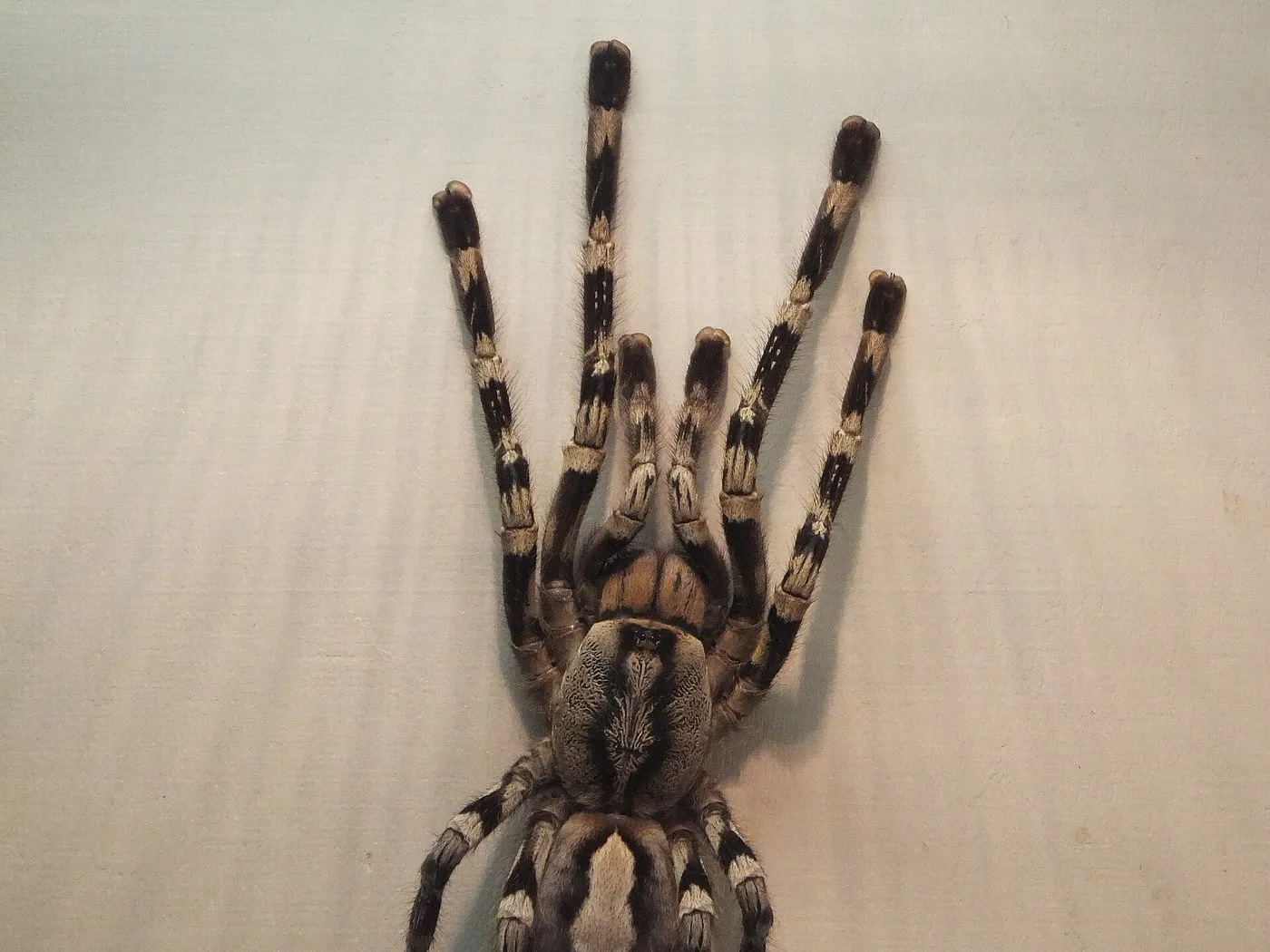
Indian ornamental tarantula
Poecilotheria regalis
Bark-patterned, lightning fast, and with a venom that can cause cramps in humans for days. Nothing for beginners and in several countries only kept under conditions.
- Group
- Spider
- Level
- Advanced
- Origin
- South Asia
Where the species comes from
- World region
- South Asia
- Countries
- Central and southern India
- Habitat
- Dry deciduous forests, retreats in tree hollows and behind bark
The app does not yet hold an origin entry for this species. The distribution given here comes from the specialist literature.
The natural habitat is the yardstick for how you furnish an enclosure. Knowing where an animal comes from is knowing why it needs heat zones, hides and a particular humidity.
Husbandry at a glance
The same details appear in the animal’s profile inside the app.
- Enclosure
- An arboreal species. In practice 30 × 30 × 45 cm is usual, securely closable.
- Temperature
- 24–28 °C.
- Humidity
- 70–75 % with good ventilation.
- Lighting
- No lighting needed.
- Substrate
- 5 cm, moisture-retaining.
- Furnishings
- Vertical cork tubes as a home, climbing branches.
- Water
- Water dish, mist regularly.
- Feeding
- Weekly; hunts very fast.
- Behaviour
- Extremely fast, usually hidden. Cornered, it threatens and bites.
- Handling
- Never pick up. Only work in the terrarium with tongs and a closed escape barrier.
- Cohabitation
- Keep singly.
- Health
- Robust provided ventilation and humidity are right.
- Seasonal cycle
- No rest period.
- Safety
- Medically significant venom: bites cause severe pain and muscle cramps for days, and medical treatment is usual. Not for households with children. Clarify the cantonal rules on venomous animals before buying.
Legal position in Switzerland
No permit foreseen
No permit required. The species does not belong to any of the groups listed in Art. 89 of the Swiss Animal Welfare Ordinance
No certificate of competence foreseen
No proof of competence required. It is only demanded for the animals named in Art. 89 of the Ordinance
Species protection applies
CITES Appendix II: Import and transfer only with papers. When buying, ask for proof of origin and captive breeding
Minimum enclosure dimensions
The Animal Welfare Ordinance does not apply to these animals: under Art. 1 it governs the handling of vertebrates, cephalopods and reptant decapods. There are therefore no minimum dimensions. Housing, climate and places to retreat should still match the needs of the species. The cantonal veterinary office can say whether cantonal rules apply, for example to venomous animals.
What the enclosure must provide
Escape-proof closure, humidity suited to the species, a retreat and water. Spiders are kept singly; most species eat their own kind.
Paperwork
Keep the CITES papers and a receipt bearing the scientific name. For Appendix II they are needed for import and transfer. Cantonal rules may apply to venomous animals; check with the cantonal veterinary office before buying.
These details are a guide, not legal advice. Binding information comes from the cantonal veterinary office; the text of the ordinance is what counts. More on the legal position

