
SpeciesPanther chameleon
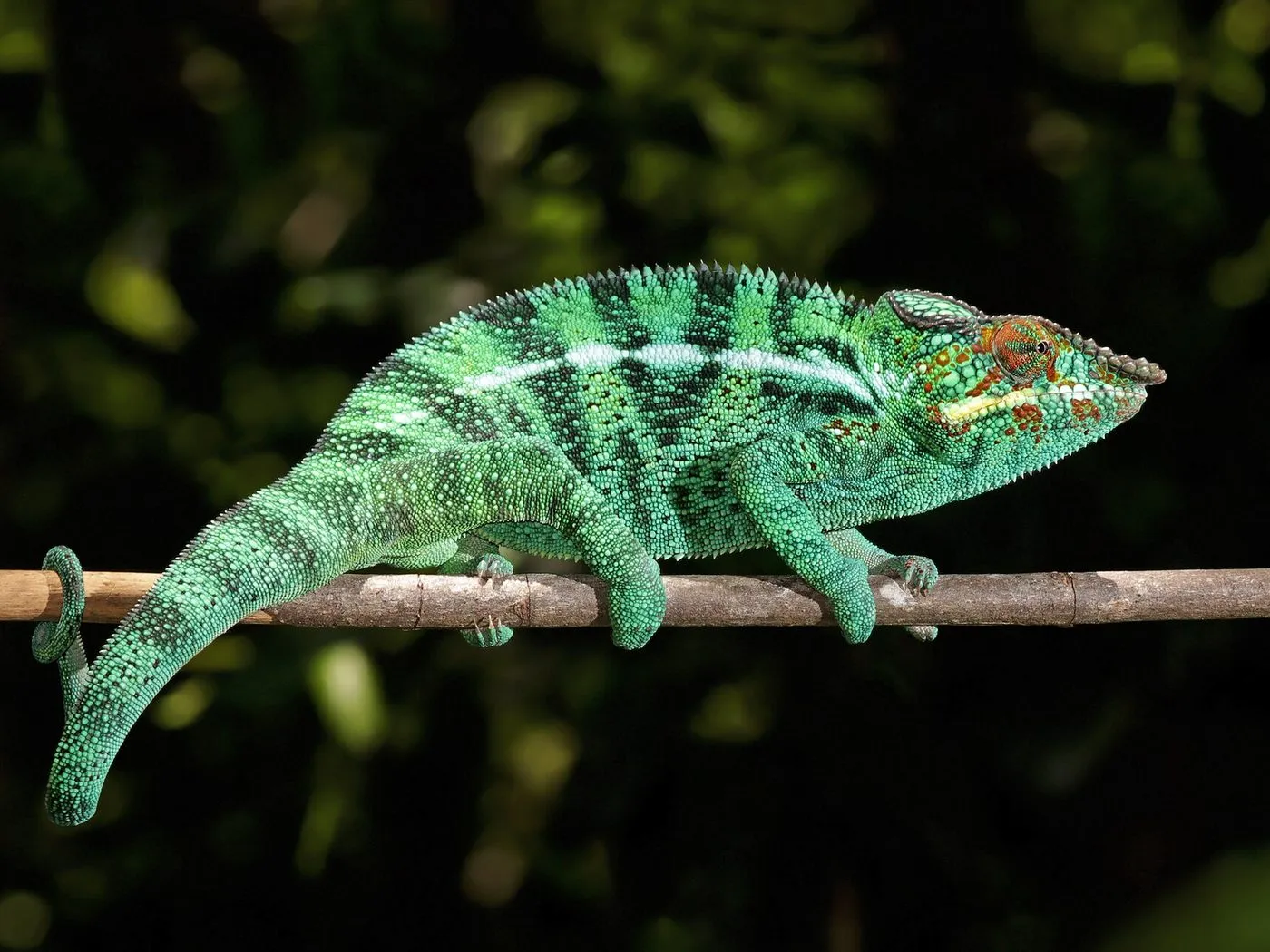
Panther chameleon
Furcifer pardalis
Vividly coloured and much sought after because of it. Like all chameleons: permit-bound, relevant under species protection law and demanding in its climate.
- Group
- Chameleon
- Level
- Advanced
- Origin
- Madagascar
Where the species comes from
- World region
- Madagascar
- Countries
- Northern and eastern Madagascar, plus introduced populations on islands in the Indian Ocean
- Habitat
- Coastal forest, scrubland, forest edges and gardens
The natural habitat is the yardstick for how you furnish an enclosure. Knowing where an animal comes from is knowing why it needs heat zones, hides and a particular humidity.
Husbandry at a glance
The same details appear in the animal’s profile inside the app.
- Enclosure
- A tall enclosure with mesh panels and dense planting.
- Temperature
- Basking spot at 32–35 °C, ambient 25–28 °C, 18–20 °C at night.
- Humidity
- 60–80 %, mist morning and evening, letting it dry in between.
- Lighting
- Strong UV-B, twelve hours.
- Substrate
- Soil if planted, otherwise bare.
- Furnishings
- Dense branchwork, plenty of plants. Visual cover matters especially for this species.
- Water
- Only droplets from leaves. Misting or a drip system, several times a day.
- Feeding
- Insects every one to two days, with calcium and vitamins.
- Behaviour
- Diurnal, slow, strictly solitary. The colour changes express mood, not camouflage.
- Handling
- Do not handle.
- Cohabitation
- Strictly alone, without sight of conspecifics.
- Health
- Kidney damage from lack of water, egg binding in females. Always provide a laying box.
- Seasonal cycle
- No winter rest: Madagascar has a rainy and a dry season. From about May to September, a drier phase follows with a night-time drop to 16–18 °C, less misting and shorter lighting. Females especially need this break — without it they lay eggs almost continuously, which exhausts them.
- Safety
- All chameleons require a permit under Art. 89 of the Ordinance.
Legal position in Switzerland
Permit required
Requires a permit. Art. 89 let. f of the Ordinance expressly names “all chameleons (Chamaeleonidae)”: Without exception and regardless of size. The cantonal veterinary office issues the permit before acquisition
Training required
Proof of competence under Art. 85 para. 3 let. c of the Ordinance is required. It is a precondition for the permit and must be obtained before acquisition
Species protection applies
CITES Appendix II: Import and transfer only with papers. When buying, ask for proof of origin and captive breeding
Minimum enclosure dimensions
Annex 2, table 5 of the Animal Welfare Ordinance does not prescribe centimetres but multiples of body length. For this species, item 13 (Arboreal true chameleons): floor area 5 × 3 body lengths, height 5 body lengths. The floor area applies to one animal; each further animal requires an additional 2 × 2 body lengths.
For this group, body length means the snout-vent length, without the tail. The largest animal in the enclosure is what counts. The enclosure may not be smaller even if fewer animals live in it than the table names.
| Snout-vent length | At least |
|---|---|
| 12 cm | 60 × 36 × 60 cm |
| 16 cm | 80 × 48 × 80 cm |
| 20 cm | 100 × 60 × 100 cm |
| 24 cm | 120 × 72 × 120 cm |
Animals may temporarily be kept in smaller enclosures: for quarantine, for the treatment of illness and injury, for acclimatisation, for breeding and rearing, and for winter or cold dormancy or aestivation (preliminary remark D on reptiles).
This is the legal lower limit, not a recommendation. An enclosure that meets exactly these dimensions is permitted, but not good for that reason. The details under “Husbandry at a glance” describe how the enclosure should be furnished, not how small it may be.
What the enclosure must provide
A permit must be applied for at the cantonal veterinary office before keeping the animal. In private keeping, a recognised certificate of competence is generally sufficient for reptiles subject to a permit, provided no further training is prescribed. The enclosure must be escape-proof and provide species-appropriate temperature zones, UV and light provision, ventilation, humidity, climbing structures, visual barriers and places to retreat. The natural social structure must be respected; many chameleons are kept singly. In addition, Art. 92 para. 1 let. h of the Ordinance requires, for chameleons, a report by an independent, recognised expert confirming that the enclosure and furnishings allow animal-appropriate keeping. Only the veiled chameleon is exempt.
Paperwork
Keep the keeping permit, certificate of competence, purchase contract and an unbroken proof of origin. For CITES-protected species, the required CITES documents and species protection checks apply to every border crossing.
These details are a guide, not legal advice. Binding information comes from the cantonal veterinary office; the text of the ordinance is what counts. More on the legal position

_male_Nosy_Be.jpg)