
SpeciesAfrican fat-tailed gecko
African fat-tailed gecko
Hemitheconyx caudicinctus
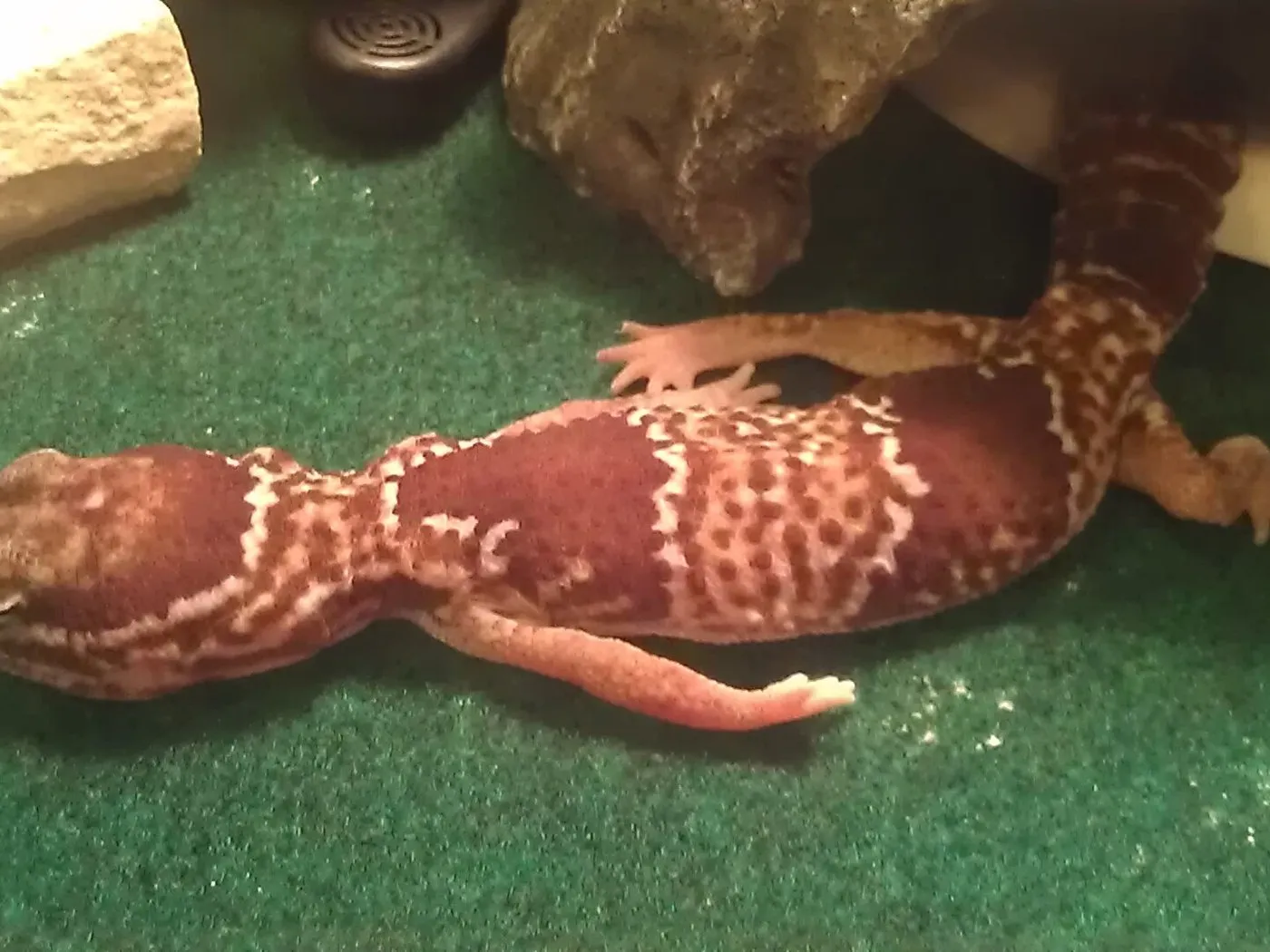
The West African relative of the leopard gecko: calmer, kept slightly moister and less common. The thick tail is a store and shows the animal's condition at a glance.
- Group
- Gecko
- Level
- Beginner
- Origin
- West Africa
Where the species comes from
- World region
- West Africa
- Countries
- From Senegal to Cameroon
- Habitat
- Dry savannah with hiding places under stones and roots
The app does not yet hold an origin entry for this species. The distribution given here comes from the specialist literature.
The natural habitat is the yardstick for how you furnish an enclosure. Knowing where an animal comes from is knowing why it needs heat zones, hides and a particular humidity.
Husbandry at a glance
The same details appear in the animal’s profile inside the app.
- Enclosure
- 100 × 50 × 50 cm for one animal. Ground dweller, height unimportant.
- Temperature
- Warm side 32 °C, cool side 25 °C, 22 °C at night. Bottom heat rather than a lamp.
- Humidity
- 50–60 %, plus a permanently moist hide.
- Lighting
- Weak UV-B is beneficial. Crepuscular, no strong lighting.
- Substrate
- Loam-sand mix, kept moist in one spot.
- Furnishings
- At least three hides at different temperatures, one of them moist.
- Water
- Shallow dish, refreshed daily.
- Feeding
- Insects every two to three days, dusted with calcium.
- Behaviour
- Crepuscular and nocturnal, calm and unhurried.
- Handling
- Tolerated. Never grip by the tail: It is dropped and grows back only misshapen.
- Cohabitation
- Alone or one male with several females.
- Health
- Shedding problems on the toes if kept too dry; the moist hide prevents them.
- Seasonal cycle
- A cooler phase of eight weeks at 20 °C.
- Safety
- No permit required.
Legal position in Switzerland
No permit foreseen
No permit required. The species does not belong to any of the groups listed in Art. 89 of the Swiss Animal Welfare Ordinance
No certificate of competence foreseen
No proof of competence required. It is only demanded for the animals named in Art. 89 of the Ordinance
No CITES listing
Not listed in the CITES appendices: Import and transfer require no species-protection papers. Keep the proof of purchase nonetheless
Minimum enclosure dimensions
Annex 2, table 5 of the Animal Welfare Ordinance does not list this species. Among snakes the table names only giant snakes (pythons and boas), elapids, vipers and pit vipers, and a few venomous or dangerous colubrids; for the rest no figure appears there.
The general rule in Annex 2 (letter K) then applies: the enclosure must be large enough for everything the species needs (hides, basking spot, climbing branches) to be arranged sensibly. As a yardstick, the ordinance points to expert opinions on a scientific basis. There is therefore no binding figure. Binding information comes from the cantonal veterinary office.
What the enclosure must provide
Provide species-appropriate heat and light zones, UV-B where needed, suitable substrate, retreats, climbing or digging options, water and natural rest periods.
Paperwork
Keep the purchase contract and proof of origin. Use the scientific name to check CITES and import status reliably.
These details are a guide, not legal advice. Binding information comes from the cantonal veterinary office; the text of the ordinance is what counts. More on the legal position

