
SpeciesSaharan spiny-tailed lizard
Saharan spiny-tailed lizard
Uromastyx geyri
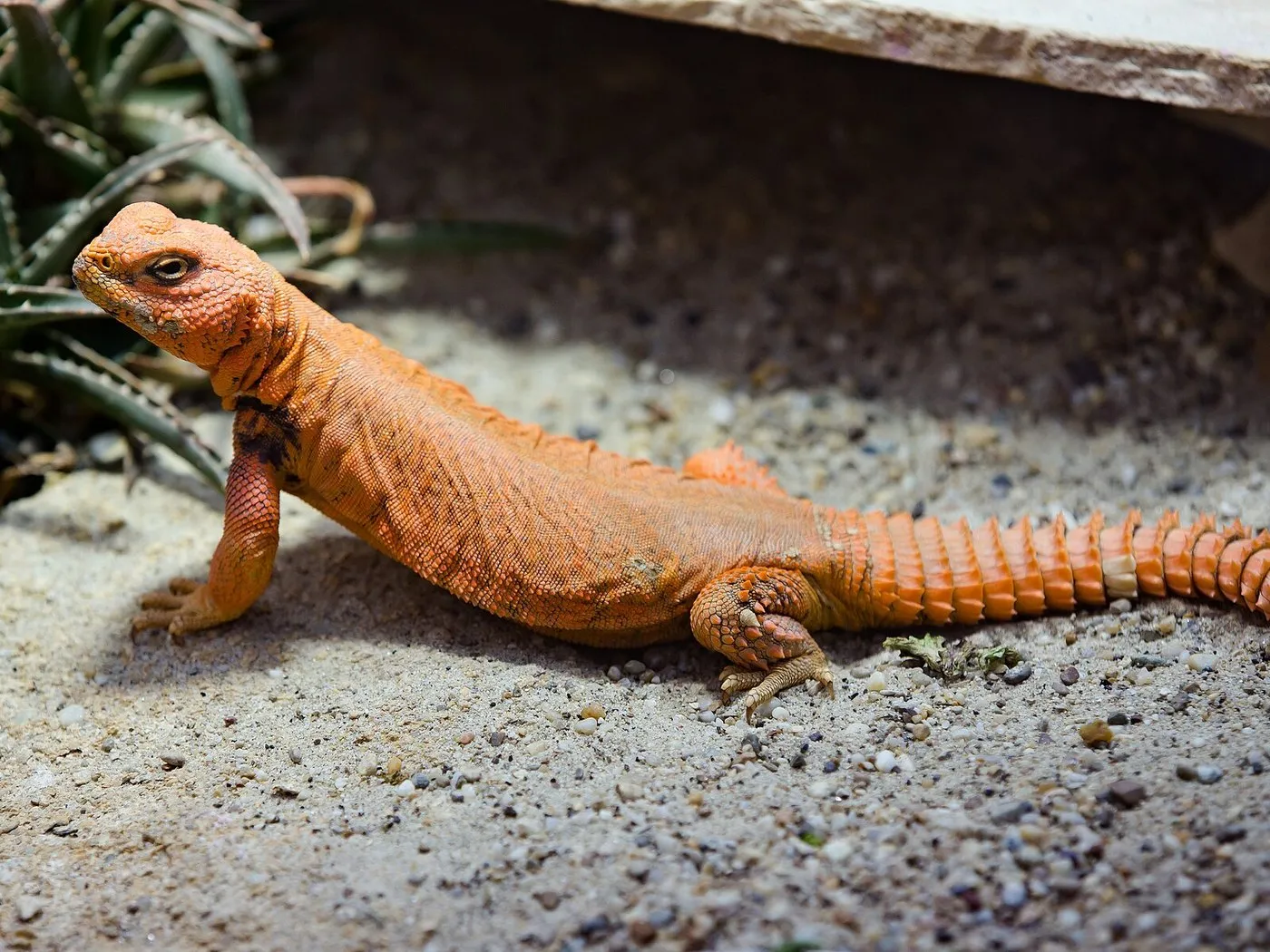
A desert herbivore that needs heat like almost no other terrarium animal. The wrong food (insects and fruit) reliably causes kidney damage in this species.
- Group
- Lizard
- Level
- Intermediate
- Origin
- North Africa
Where the species comes from
- World region
- North Africa
- Countries
- Algeria, Niger and Mali, central Sahara
- Habitat
- Stony desert with rock crevices and sparse vegetation
The app does not yet hold an origin entry for this species. The distribution given here comes from the specialist literature.
The natural habitat is the yardstick for how you furnish an enclosure. Knowing where an animal comes from is knowing why it needs heat zones, hides and a particular humidity.
Husbandry at a glance
The same details appear in the animal’s profile inside the app.
- Enclosure
- Ground-oriented, with deep substrate for digging.
- Temperature
- Spot basking at 50–55 °C, ambient 30–35 °C, cool corner 25 °C, 18–20 °C at night.
- Humidity
- 20–30 %. Humidity is a health risk for this species.
- Lighting
- Very strong UV-B, fourteen hours. This species tolerates and needs more than most.
- Substrate
- At least 20 cm of loam-sand mix, firm enough for stable tunnels.
- Furnishings
- Stone slabs as substitute crevices, set directly on the floor.
- Water
- Small dish, hardly used. The need is met by the green food.
- Feeding
- Plants only: herbs, flowers, dandelion, few legumes. No insects, no fruit.
- Behaviour
- Diurnal, digs extensively, flees into its burrow and blocks it with its spiny tail.
- Handling
- Neither necessary nor desirable.
- Cohabitation
- Alone. Pairs only temporarily for breeding.
- Health
- Kidney damage from animal protein and temperatures that are too low is the most common cause of death.
- Seasonal cycle
- A cooler rest period of six to eight weeks at 18–20 °C.
- Safety
- No permit required. Uromastyx species are CITES-protected.
Legal position in Switzerland
No permit foreseen
No permit required. The species does not belong to any of the groups listed in Art. 89 of the Swiss Animal Welfare Ordinance
No certificate of competence foreseen
No proof of competence required. It is only demanded for the animals named in Art. 89 of the Ordinance
Species protection applies
CITES Appendix II: Import and transfer only with papers. When buying, ask for proof of origin and captive breeding
Minimum enclosure dimensions
Annex 2, table 5 of the Animal Welfare Ordinance does not prescribe centimetres but multiples of body length. For this species, item 23 (Spiny-tailed lizards): floor area 5 × 4 body lengths, height 3 body lengths. The floor area applies to at most two animals; each further animal requires an additional 2 × 2 body lengths.
For this group, body length means the snout-vent length, without the tail. The largest animal in the enclosure is what counts. The enclosure may not be smaller even if fewer animals live in it than the table names.
| Snout-vent length | At least |
|---|---|
| 12 cm | 60 × 48 × 36 cm |
| 15 cm | 75 × 60 × 45 cm |
| 18 cm | 90 × 72 × 54 cm |
Animals may temporarily be kept in smaller enclosures: for quarantine, for the treatment of illness and injury, for acclimatisation, for breeding and rearing, and for winter or cold dormancy or aestivation (preliminary remark D on reptiles).
This is the legal lower limit, not a recommendation. An enclosure that meets exactly these dimensions is permitted, but not good for that reason. The details under “Husbandry at a glance” describe how the enclosure should be furnished, not how small it may be.
What the enclosure must provide
Provide species-appropriate heat and light zones, UV-B where needed, suitable substrate, retreats, climbing or digging options, water and natural rest periods.
Paperwork
Keep the purchase contract and proof of origin. Use the scientific name to check CITES and import status reliably.
These details are a guide, not legal advice. Binding information comes from the cantonal veterinary office; the text of the ordinance is what counts. More on the legal position

_a.jpg)