
SpeciesGreen anole
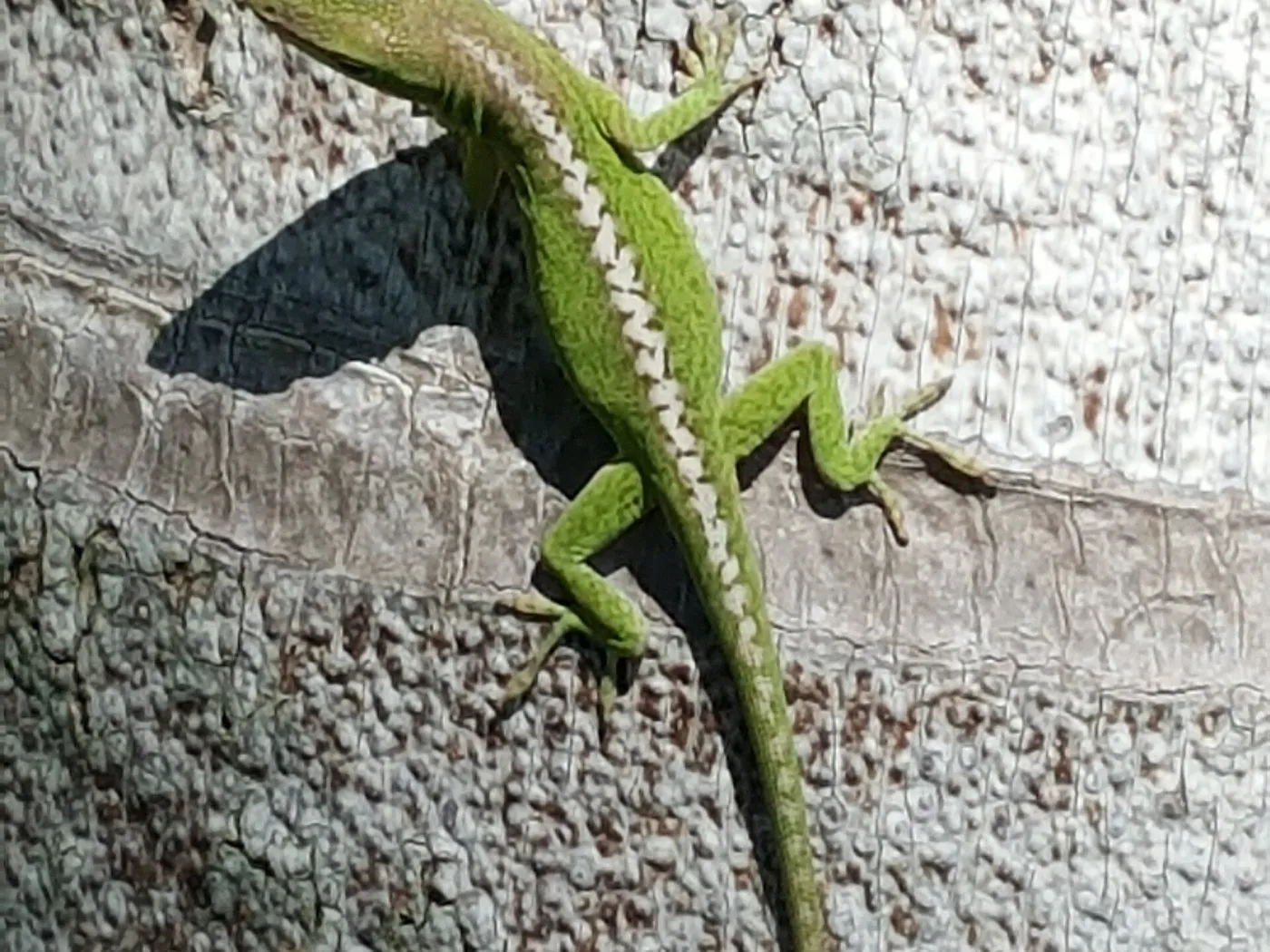
Green anole
Anolis carolinensis
One of the few small lizards that truly show themselves in a planted terrarium. It does not become tame: Anyone looking for a lizard to handle is in the wrong place.
- Group
- Lizard
- Level
- Beginner
- Origin
- North America
Where the species comes from
- World region
- North America
- Countries
- South-eastern United States, from Texas to North Carolina
- Habitat
- Warm humid forests, scrub and gardens
The app does not yet hold an origin entry for this species. The distribution given here comes from the specialist literature.
The natural habitat is the yardstick for how you furnish an enclosure. Knowing where an animal comes from is knowing why it needs heat zones, hides and a particular humidity.
Husbandry at a glance
The same details appear in the animal’s profile inside the app.
- Enclosure
- Height before floor area, densely planted.
- Temperature
- Basking spot at 32 °C, ambient 24–28 °C, 18–20 °C at night.
- Humidity
- 60–70 %, mist morning and evening.
- Lighting
- UV-B needed, twelve hours of light.
- Substrate
- Forest floor of soil and leaf litter, which holds the moisture.
- Furnishings
- Densely planted, many thin branches and broad leaves for basking.
- Water
- It drinks from leaves; provide a small dish as well.
- Feeding
- Small insects every two days, dusted with calcium and vitamins.
- Behaviour
- Diurnal and very agile. Males show the red dewlap in territorial disputes and courtship.
- Handling
- Do not handle. The tail breaks off easily when gripped and grows back only partially.
- Cohabitation
- One male with one to two females. Two males fight constantly.
- Health
- Desiccation from too little humidity is the most common cause of loss.
- Seasonal cycle
- A light winter rest at 18–20 °C with a shorter photoperiod.
- Safety
- No permit required.
Legal position in Switzerland
No permit foreseen
No permit required. The species does not belong to any of the groups listed in Art. 89 of the Swiss Animal Welfare Ordinance
No certificate of competence foreseen
No proof of competence required. It is only demanded for the animals named in Art. 89 of the Ordinance
No CITES listing
Not listed in the CITES appendices: Import and transfer require no species-protection papers. Keep the proof of purchase nonetheless
Minimum enclosure dimensions
Annex 2, table 5 of the Animal Welfare Ordinance does not prescribe centimetres but multiples of body length. For this species, item 17a (Anoles): floor area 6 × 6 body lengths, height 8 body lengths. The floor area applies to at most two animals; each further animal requires an additional 2 × 2 body lengths.
For this group, body length means the snout-vent length, without the tail. The largest animal in the enclosure is what counts. The enclosure may not be smaller even if fewer animals live in it than the table names.
| Snout-vent length | At least |
|---|---|
| 5 cm | 30 × 30 × 40 cm |
| 6 cm | 36 × 36 × 48 cm |
| 7 cm | 42 × 42 × 56 cm |
| 8 cm | 48 × 48 × 64 cm |
Animals may temporarily be kept in smaller enclosures: for quarantine, for the treatment of illness and injury, for acclimatisation, for breeding and rearing, and for winter or cold dormancy or aestivation (preliminary remark D on reptiles).
This is the legal lower limit, not a recommendation. An enclosure that meets exactly these dimensions is permitted, but not good for that reason. The details under “Husbandry at a glance” describe how the enclosure should be furnished, not how small it may be.
What the enclosure must provide
Provide species-appropriate heat and light zones, UV-B where needed, suitable substrate, retreats, climbing or digging options, water and natural rest periods.
Paperwork
Keep the purchase contract and proof of origin. Use the scientific name to check CITES and import status reliably.
These details are a guide, not legal advice. Binding information comes from the cantonal veterinary office; the text of the ordinance is what counts. More on the legal position

