
SpeciesAfrican clawed frog
African clawed frog
Xenopus laevis
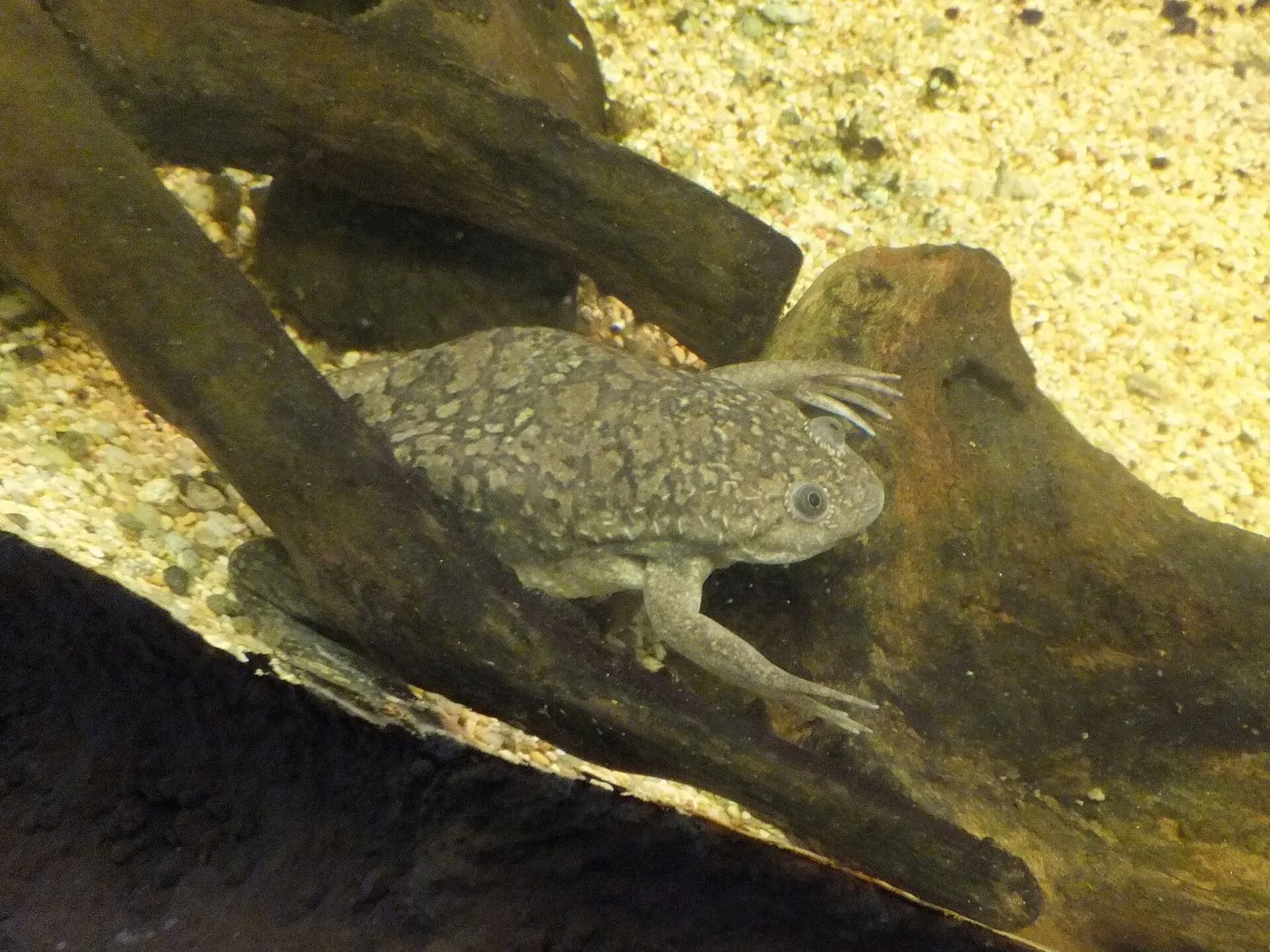
A fully aquatic, tongueless frog that pushes prey into its mouth with its front legs. A laboratory animal for decades and therefore remarkably undemanding, already established in Europe as a non-native species.
- Group
- Amphibian
- Level
- Beginner
- Origin
- Southern Africa
Where the species comes from
- World region
- Southern Africa
- Countries
- South Africa, Namibia, Botswana
- Habitat
- Standing waters, including turbid and nutrient-rich ones
The app does not yet hold an origin entry for this species. The distribution given here comes from the specialist literature.
The natural habitat is the yardstick for how you furnish an enclosure. Knowing where an animal comes from is knowing why it needs heat zones, hides and a particular humidity.
Husbandry at a glance
The same details appear in the animal’s profile inside the app.
- Enclosure
- For two animals the Animal Welfare Ordinance requires an aquarium of at least 6 × 4 body lengths of water surface and 4 body lengths of depth, i.e. 72 × 48 cm with a depth of 48 cm for females of 12 cm, 78 × 52 cm with a depth of 52 cm for large females up to 13 cm. Add 2 × 2 body lengths for each further animal.
- Temperature
- 18–24 °C. No heater needed.
- Humidity
- Aquatic.
- Lighting
- Dim.
- Substrate
- Fine sand or bare bottom; gravel gets swallowed.
- Furnishings
- Caves, sturdy plants. The lid must close tightly: The animals climb out.
- Water
- Filter, weekly partial water change.
- Feeding
- Two to three times a week, earthworms, pellets, frozen food.
- Behaviour
- Fully aquatic, surfaces to breathe. Very food-focused.
- Handling
- Do not handle; the skin is slippery and delicate.
- Cohabitation
- Groups of equally sized animals.
- Health
- Very robust. Obesity from feeding too often.
- Seasonal cycle
- No rest period needed.
- Safety
- No permit required. Releasing is forbidden and particularly consequential: the species can transmit the chytrid fungus, which causes amphibian populations to collapse worldwide.
Legal position in Switzerland
No permit foreseen
No permit required. The species does not belong to any of the groups listed in Art. 89 of the Swiss Animal Welfare Ordinance
No certificate of competence foreseen
No proof of competence required. It is only demanded for the animals named in Art. 89 of the Ordinance
No CITES listing
Not listed in the CITES appendices: Import and transfer require no species-protection papers. Keep the proof of purchase nonetheless
Minimum enclosure dimensions
Annex 2, table 6 of the Animal Welfare Ordinance does not prescribe centimetres but multiples of body length. For this species, item 5 (Clawed frogs and Surinam toads of tropical waters): water section 6 × 4 at 4 body lengths depth. The figure applies to at most two animals; each further animal requires an additional 2 × 2 body lengths.
For this group, body length means the total length of the animal, from snout to the end of the body. The largest animal in the enclosure is what counts. The enclosure may not be smaller even if fewer animals live in it than the table names.
| Total length | At least |
|---|---|
| 6 cm | Water section 36 × 24 cm, depth 24 cm |
| 8 cm | Water section 48 × 32 cm, depth 32 cm |
| 10 cm | Water section 60 × 40 cm, depth 40 cm |
| 12 cm | Water section 72 × 48 cm, depth 48 cm |
| 14 cm | Water section 84 × 56 cm, depth 56 cm |
Animals may temporarily be kept in smaller enclosures: for quarantine, for the treatment of illness and injury, for acclimatisation, for breeding and rearing, and for winter or cold dormancy (note a to table 6).
This is the legal lower limit, not a recommendation. An enclosure that meets exactly these dimensions is permitted, but not good for that reason. The details under “Husbandry at a glance” work out this minimum for adult animals; they give the minimum, not the ideal.
What the enclosure must provide
A tightly closing lid, clean filtered water, fine sand instead of gravel. Releasing is forbidden. The species counts as invasive in Europe and can transmit the chytrid fungus.
Paperwork
Keep the purchase contract and proof of origin. Use the scientific name to check CITES and import status reliably.
These details are a guide, not legal advice. Binding information comes from the cantonal veterinary office; the text of the ordinance is what counts. More on the legal position

