
SpeciesAxolotl
Axolotl
Ambystoma mexicanum
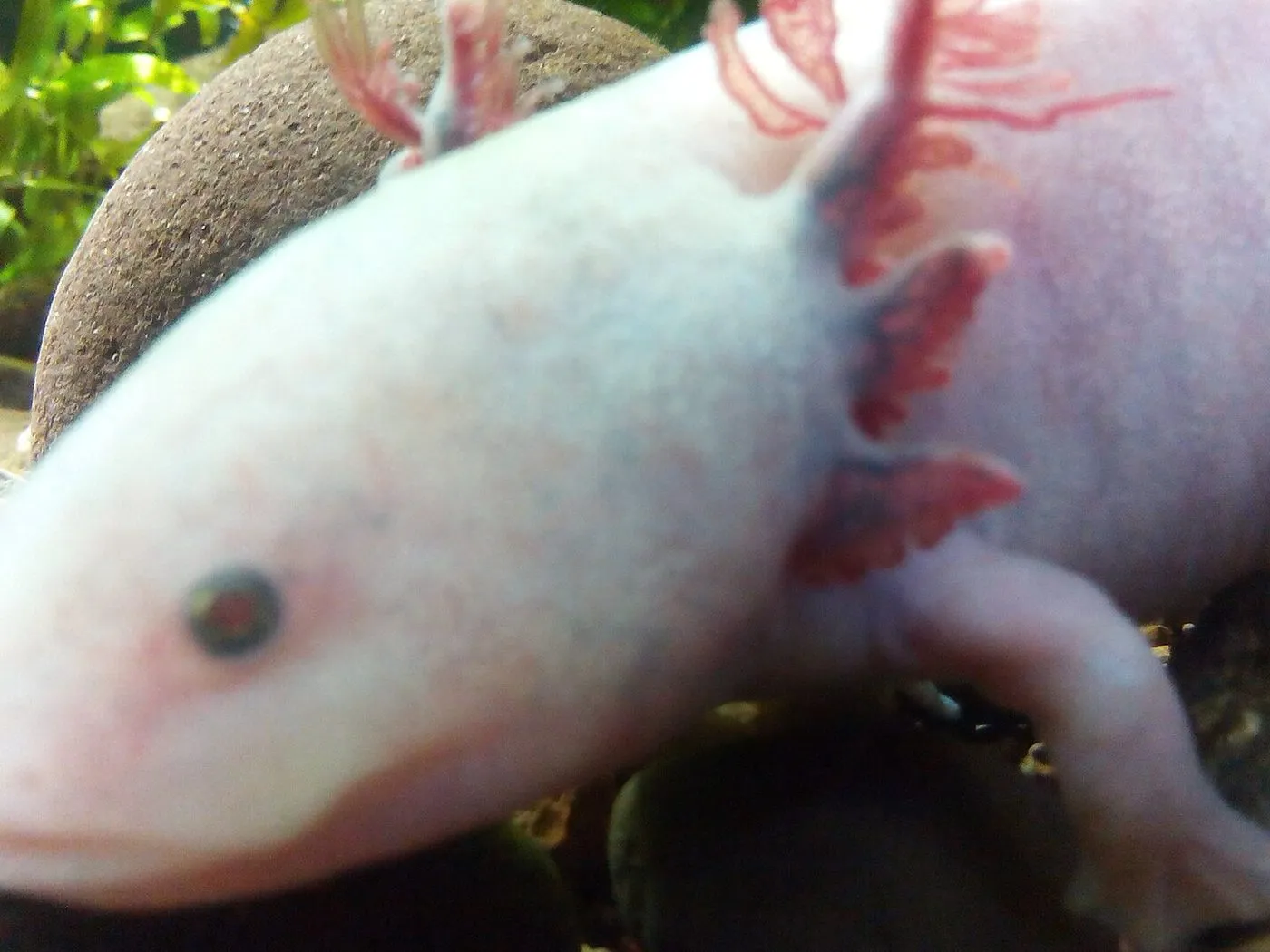
A salamander that remains permanently in its larval stage. It lives in a cool aquarium. Warmth is not pleasant for it but harmful.
- Group
- Amphibian
- Level
- Beginner
- Origin
- Mexico
Where the species comes from
- World region
- Mexico
- Countries
- Originally the Xochimilco lake system in the Valley of Mexico
- Habitat
- Cool, plant-rich freshwater canals and lakes
The natural habitat is the yardstick for how you furnish an enclosure. Knowing where an animal comes from is knowing why it needs heat zones, hides and a particular humidity.
Husbandry at a glance
The same details appear in the animal’s profile inside the app.
- Enclosure
- An aquarium for two animals of at least 4 × 2 snout-vent lengths of water surface and 2 snout-vent lengths of depth under the Animal Welfare Ordinance, i.e. 60 × 30 cm with 30 cm depth at 15 cm; add 1 × 1 snout-vent length for each further animal. An aquarium from 100 × 40 cm is recommended.
- Temperature
- 15–19 °C. Above 22 °C it becomes dangerous: Cooling is often needed in summer, heating never.
- Humidity
- Aquatic.
- Lighting
- Dim. Axolotls avoid bright light.
- Substrate
- Fine sand or bare bottom. Gravel gets swallowed and causes intestinal blockage.
- Furnishings
- Caves of clay or cork, plants as visual cover. Quiet matters more than structure.
- Water
- Cool, clean water with gentle flow, a low-output filter, weekly partial change.
- Feeding
- Two to three times a week, earthworms, water fleas or pellets. No fish as a staple.
- Behaviour
- Crepuscular, calm, usually rests on the bottom. Regenerates lost limbs.
- Handling
- Do not handle. The skin is delicate and has no scales.
- Cohabitation
- Alone or with equally sized animals. Smaller ones get bitten.
- Health
- Warmth above 22 °C leads to fungal infection and loss of appetite: By far the most common problem.
- Seasonal cycle
- No rest period needed; keep evenly cool.
- Safety
- No permit required. Almost extinct in the wild; all animals in the trade are captive-bred.
Legal position in Switzerland
No permit foreseen
No permit required. The species does not belong to any of the groups listed in Art. 89 of the Swiss Animal Welfare Ordinance
No certificate of competence foreseen
No proof of competence required. It is only demanded for the animals named in Art. 89 of the Ordinance
Species protection applies
CITES Appendix II: Import and transfer only with papers. When buying, ask for proof of origin and captive breeding
Minimum enclosure dimensions
Annex 2, table 6 of the Animal Welfare Ordinance does not prescribe centimetres but multiples of body length. For this species, item 13 (Axolotl and other neotenic, fully aquatic mole salamanders): water section 4 × 2 at 2 body lengths depth. The figure applies to at most two animals; each further animal requires an additional 1 × 1 body lengths.
For this group, body length means the snout-vent length, without the tail. The largest animal in the enclosure is what counts. The enclosure may not be smaller even if fewer animals live in it than the table names.
| Snout-vent length | At least |
|---|---|
| 10 cm | Water section 40 × 20 cm, depth 20 cm |
| 12 cm | Water section 48 × 24 cm, depth 24 cm |
| 14 cm | Water section 56 × 28 cm, depth 28 cm |
| 16 cm | Water section 64 × 32 cm, depth 32 cm |
Animals may temporarily be kept in smaller enclosures: for quarantine, for the treatment of illness and injury, for acclimatisation, for breeding and rearing, and for winter or cold dormancy (note a to table 6).
This is the legal lower limit, not a recommendation. An enclosure that meets exactly these dimensions is permitted, but not good for that reason. The details under “Husbandry at a glance” work out this minimum for adult animals; they give the minimum, not the ideal.
What the enclosure must provide
Cool, clean water with gentle flow, fine sand instead of gravel, retreat caves. Releasing is forbidden.
Paperwork
Keep the purchase contract and proof of origin. Use the scientific name to check CITES and import status reliably.
These details are a guide, not legal advice. Binding information comes from the cantonal veterinary office; the text of the ordinance is what counts. More on the legal position

