
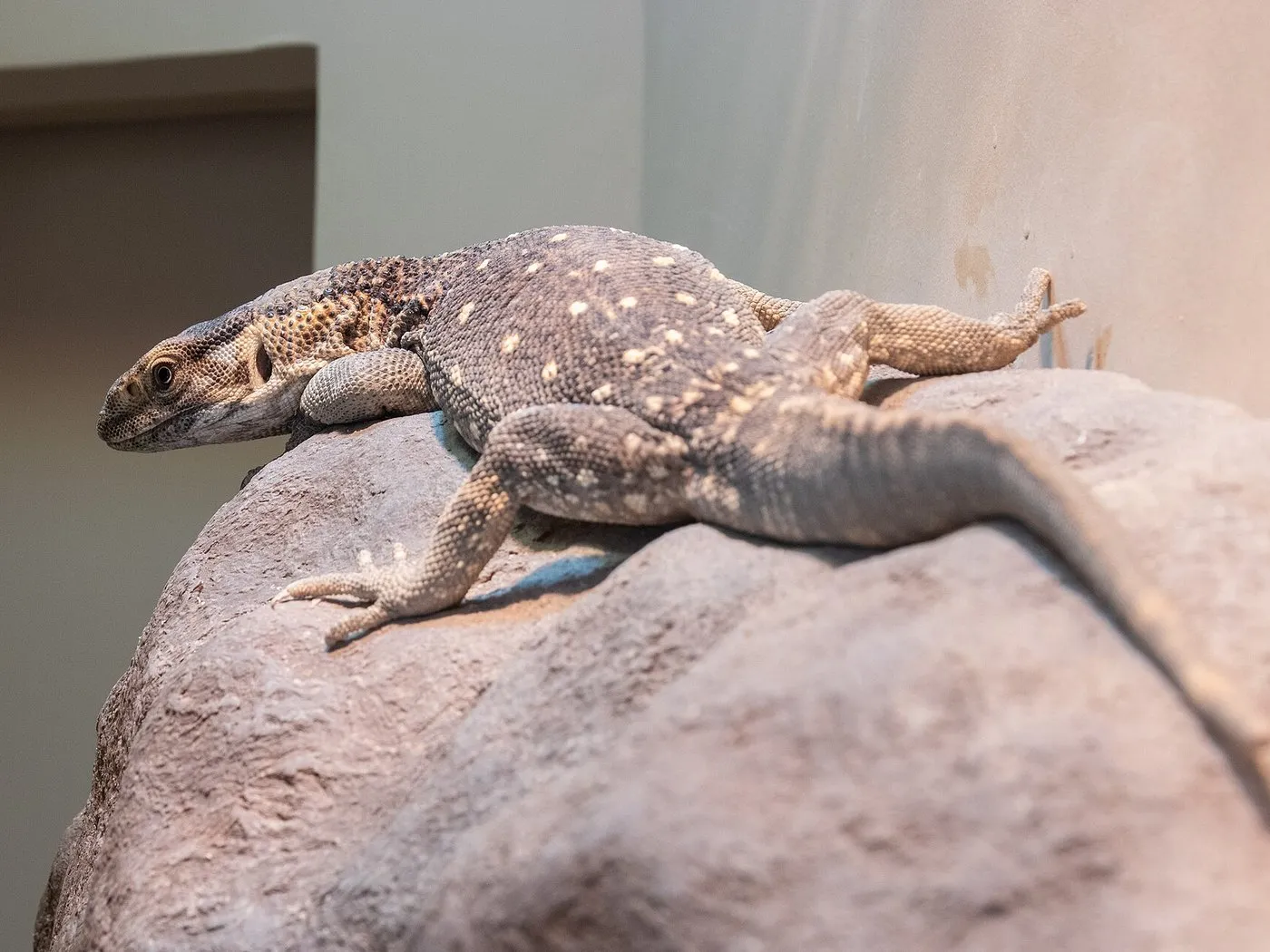
SpeciesSavannah monitor
Savannah monitor
Varanus exanthematicus
Often sold as a tame beginner's animal and almost as often kept overweight and in too little space. A monitor that needs a room and, in Switzerland, a permit.
- Group
- Lizard
- Level
- Advanced
- Origin
- Africa
Where the species comes from
- World region
- Africa
- Countries
- Savannahs south of the Sahara, from Senegal to Sudan
- Habitat
- Dry savannah with burrows and termite mounds
The app does not yet hold an origin entry for this species. The distribution given here comes from the specialist literature.
The natural habitat is the yardstick for how you furnish an enclosure. Knowing where an animal comes from is knowing why it needs heat zones, hides and a particular humidity.
Husbandry at a glance
The same details appear in the animal’s profile inside the app.
- Enclosure
- Very deep digging substrate and plenty of floor area.
- Temperature
- Spot basking at 50 °C, ambient 28–32 °C, cool corner 24 °C, 22 °C at night.
- Humidity
- 60–70 % in the substrate, drier above.
- Lighting
- Strong UV-B, twelve hours.
- Substrate
- 50–60 cm of moist loam-sand mix. Monitors dig deep tunnels; shallow substrate is cruelty by design.
- Furnishings
- Large hides, a stable climbing structure, a bathing basin.
- Water
- Large bathing basin.
- Feeding
- Insects, snails, occasionally an egg or a rodent. Two to three times a week: In this species obesity is the rule, not the exception.
- Behaviour
- Diurnal, digs, climbs, explores tirelessly. Highly capable of learning.
- Handling
- Habituation is possible, force does harm. Powerful tail lash and bite.
- Cohabitation
- Kept singly.
- Health
- Obesity and fatty liver from feeding rodents and too little exercise are the most common cause of death.
- Seasonal cycle
- Six to ten weeks of dry season with a night-time drop to 20–22 °C and reduced feeding. In the West African savanna, the savannah monitor retreats during this time. Without this phase, animals in human care tend towards obesity and fatty liver disease.
- Safety
- Monitors over one metre in total length require a permit under Art. 89 of the Ordinance and proof of competence. The savannah monitor reaches about a metre: Obtain the permit before buying.
Legal position in Switzerland
Permit required
Requires a permit. Art. 89 let. f of the Ordinance covers monitors reaching more than 1 m total length as adults. Large savannah monitors reach this length, and Annex 2, Table 5 of the Ordinance lists the species under item 36 as requiring a permit
Training required
Proof of competence under Art. 85 para. 3 let. c of the Ordinance is required. It is a precondition for the permit and must be obtained before acquisition
Species protection applies
CITES Appendix II: Import and transfer only with papers. When buying, ask for proof of origin and captive breeding
Minimum enclosure dimensions
Annex 2, table 5 of the Animal Welfare Ordinance does not prescribe centimetres but multiples of body length. For this species, item 36 (Large ground-dwelling monitors from dry regions): floor area 5 × 3 body lengths, height 2 body lengths. The floor area applies to at most two animals; each further animal requires an additional 2 × 2 body lengths.
For this group, body length means the snout-vent length, without the tail. The largest animal in the enclosure is what counts. The enclosure may not be smaller even if fewer animals live in it than the table names.
| Snout-vent length | At least |
|---|---|
| 30 cm | 150 × 90 × 60 cm |
| 40 cm | 200 × 120 × 80 cm |
| 50 cm | 250 × 150 × 100 cm |
Animals may temporarily be kept in smaller enclosures: for quarantine, for the treatment of illness and injury, for acclimatisation, for breeding and rearing, and for winter or cold dormancy or aestivation (preliminary remark D on reptiles).
This is the legal lower limit, not a recommendation. An enclosure that meets exactly these dimensions is permitted, but not good for that reason. The details under “Husbandry at a glance” describe how the enclosure should be furnished, not how small it may be.
What the enclosure must provide
Provide species-appropriate heat and light zones, UV-B where needed, suitable substrate, retreats, climbing or digging options, water and natural rest periods.
Paperwork
Keep the purchase contract and proof of origin. Use the scientific name to check CITES and import status reliably.
These details are a guide, not legal advice. Binding information comes from the cantonal veterinary office; the text of the ordinance is what counts. More on the legal position

